
Do Directory Submissions Still Work for SEO in 2026?

Do Directory Submissions Still Work for SEO in 2026?
Directory submissions still play a role in SEO, but their impact has significantly decreased compared to earlier years. In 2026, quality matters far more than quantity. Submitting your website to reputable, niche-specific directories can help establish credibility, improve local search rankings, and drive targeted referral traffic. However, low-quality directories, automated submissions, and inconsistent business details (NAP) can harm your SEO and even result in penalties.
Key Takeaways:
- Declining Importance: Citations now influence only 7–10% of local search rankings, down from 15–20% in the past.
- Quality Over Quantity: Only 15% of directories created after 2010 meet editorial standards that provide real value.
- Risks of Low-Quality Directories: Spammy directories can lead to penalties, harm your reputation, and confuse search engines.
- When They Work: High-quality directories help new domains get indexed, diversify link profiles, and generate referral traffic.
- Best Practices: Focus on NAP consistency, target industry-specific directories, and track results using UTM parameters and analytics.
In short, directory submissions can still be effective if approached selectively and strategically. Avoid outdated tactics like mass submissions and prioritize directories that align with modern SEO standards.
Why Directory Submissions Are Being Questioned in 2026
Google Algorithm Updates and Their Impact
Google's approach to evaluating directory links has undergone a major transformation. Instead of focusing on the sheer number of citations, the search engine now prioritizes quality, consistency, and user engagement signals. Thanks to advancements in AI and machine learning, Google can easily differentiate between genuine business listings and manipulative link-building tactics.
This shift has significantly reduced the importance of citations in local pack rankings. Previously accounting for 15–20%, they now contribute only 7–10% to these rankings. Adding to this, Google's SpamBrain AI, updated in January 2026, aggressively targets AI-generated link schemes. Suspicious directory links are effectively ignored, offering no SEO advantage and posing considerable risks instead.
The Problem with Low-Quality Directories
The internet is saturated with directories that add little to no value. Research indicates that only 15% of directories created after 2010 meet editorial standards that could benefit SEO. Many low-quality directories rely on automated approvals, cramming irrelevant or thin content onto single pages. Being listed alongside spammy or poorly maintained sites can harm your site's reputation, creating a "bad neighborhood" effect.
On top of that, 73% of consumers lose trust in businesses when they encounter inconsistent information online. Low-quality directories often display outdated or incorrect details, such as phone numbers, addresses, or business names. This not only confuses search engines but also alienates potential customers. The result? A double hit to both credibility and SEO.
Spam Risks and Negative SEO Consequences
Automated submission tools pose one of the biggest risks. These tools blast business details to hundreds of directories in one go, a tactic Google explicitly warns against. Links generated without human oversight are flagged as spam, and websites employing this approach risk being entirely deindexed for unnatural link schemes.
"The majority of free directory listings are considered junk sites that can harm your SEO more than help it."
– Gombos Atila Robert, CEO, Jasmine Business Directory
Directories that demand reciprocal links - requiring you to link back to them - are another red flag. Such practices are often considered manipulative and can result in manual penalties from Google. Many of these directories are tied to Private Blog Networks (PBNs) or link wheels, which are specifically targeted by Google's 2026 spam updates. Severe violations can lead to Manual Actions in Google Search Console, potentially removing your site from search results altogether.
The issue of fragmentation adds to these risks. Submitting to numerous low-quality directories often results in inconsistent Name, Address, and Phone (NAP) data across the web. This not only confuses search engines but also weakens your local SEO efforts. Combined, these factors highlight why directory submissions are facing growing skepticism in 2026.
Local Business SEO Link Building Tips 2024
When Directory Submissions Still Work in 2026
Even as digital strategies evolve, directory submissions still hold value - if used wisely. In 2026, the focus has shifted from sheer quantity to strategic selectivity. Instead of submitting your business to countless directories, choosing the right ones at the right time can yield tangible results.
Getting New Domains Indexed and Visible
For brand-new websites, directory submissions can speed up the indexing process. When a domain launches without backlinks, search engine crawlers may struggle to discover it. High-quality directory listings act as pathways for crawlers, signaling to Google that your business is live and active.
Directories also help establish credibility during those critical first 6–12 months. Beyond indexing, they add variety to your link profile, which is essential for long-term SEO success.
Building a Diverse Link Profile
A strong backlink profile thrives on variety, and directories contribute both dofollow and nofollow links from different sources. This type of diversity is important because Google favors natural link patterns over anything that looks manufactured.
Including quality directory links as 20–30% of your backlink mix has been linked to a 68% higher likelihood of ranking in the Local Pack. Beyond traditional link-building, directories now play a role in AI-driven search tools like ChatGPT and Perplexity, which rely on structured business data to answer local queries. Additionally, reputable directories help maintain NAP (Name, Address, Phone number) consistency, a key factor for local SEO success.
Generating Targeted Referral Traffic
Quality directories do more than enhance link diversity - they also bring in targeted referral traffic. Users of these platforms often have high intent, meaning they’re further along in their decision-making process than casual browsers. This makes directory traffic especially valuable. For example, industry-specific directories boast conversion rates between 15–22%, significantly higher than the 5–9% seen with general directories.
| Directory Type | Average Conversion Rate | Typical Cost per Lead |
|---|---|---|
| Industry-Specific | 15–22% | $8–$20 |
| Local Directories | 12–18% | $5–$15 |
| General Business Directories | 5–9% | $15–$30 |
Listings that include photos and videos perform even better, generating 3× more engagement and 40% higher click-through rates compared to text-only profiles. Businesses that invest in quality directory listings often see a 23% boost in local search visibility within just six months. To maximize results, track performance using UTM parameters in Google Analytics to pinpoint which directories drive the best referral traffic.
How to Select the Right Directories for SEO
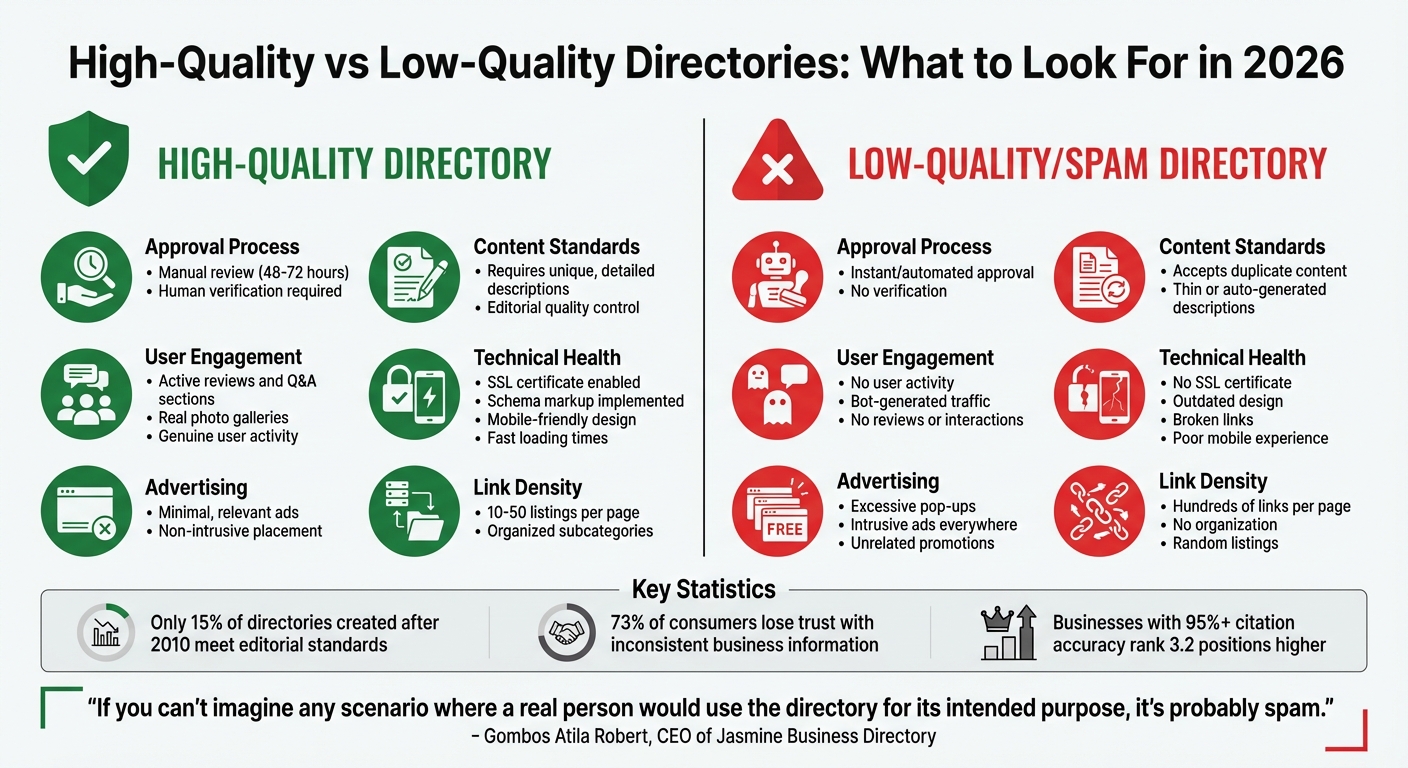
High-Quality vs Low-Quality Directory Comparison for SEO 2026
By 2026, the landscape of SEO has shifted - fewer directories truly enhance rankings, and quality now outweighs quantity.
What Makes a Directory High-Quality
The hallmark of a top-tier directory is manual editorial review. Reputable platforms rely on human reviewers to confirm a business's legitimacy and ensure content isn't duplicated. If a directory approves your submission instantly, that’s a glaring warning sign.
Another key factor is niche and geographic relevance. A link from a DA 35 directory tailored to your industry often carries more weight than a DA 50 generic directory. For instance, a law firm listed on Avvo will likely perform better in search rankings than one listed in a general business directory.
"A directory's value isn't just about the backlink - it's about the trust signals it sends to search engines and the qualified traffic it can drive to your website." - Gombos Atila Robert, CEO, Jasmine Business Directory
Directories with real organic traffic and genuine user engagement are also more valuable. Tools like Ahrefs or SEMrush can help you confirm whether a directory ranks for industry-specific terms and attracts actual visitors. Features like active reviews, Q&A sections, and photo galleries often signal authentic user activity. Additionally, directories using LocalBusiness schema markup and maintaining SSL certificates demonstrate technical standards that search engines prioritize.
| Quality Indicator | High-Quality Directory | Low-Quality/Spam Directory |
|---|---|---|
| Approval Process | Manual review (48-72 hours) | Instant/automated approval |
| Content Standards | Requires unique, detailed descriptions | Accepts duplicate or thin content |
| User Engagement | Active reviews, Q&A, and photos | No user activity or bot-generated traffic |
| Technical Health | SSL, schema markup, mobile-friendly | No SSL, outdated design, broken links |
| Advertising | Minimal, relevant ads | Excessive, intrusive pop-ups/ads |
How to Avoid Low-Value Directories
To protect your SEO efforts, it’s crucial to carefully vet directories before submitting your business. Only a small percentage meet the necessary quality standards, so due diligence is key.
Start by performing a quick search using terms like "[directory name] + spam" or "[directory name] + penalty" to identify any past issues reported by other webmasters. Confirm that the directory organizes listings into specific, relevant subcategories.
Pay attention to link density. High-quality directories typically limit listings to 10-50 per page, while spam directories often cram hundreds of irrelevant links onto a single page. Be cautious of directories that require a reciprocal link back to maintain your listing - this outdated practice can put your site at risk of penalties.
"If you can't imagine any scenario where a real person would use the directory for its intended purpose, it's probably spam." - Gombos Atila Robert, PhD, CEO of Jasmine Business Directory
Use backlink tools to audit where your competitors are listed. If successful businesses in your field are utilizing a directory, that’s usually a good sign. On the other hand, directories filled with dead links or inactive domains are best avoided. It’s worth noting that businesses with 95% or higher citation accuracy tend to rank an average of 3.2 positions higher in local search results compared to those with just 70% accuracy.
sbb-itb-5806a15
Boost Your Project's Visibility
Submit your project to Directory Hunt to gain visibility, reach early adopters, and connect with a community of makers and entrepreneurs.
Submit Your ProjectBest Practices for Directory Submissions in 2026
Once you've pinpointed the right directories, how you submit your details becomes just as critical as where you submit them. These strategies build on earlier methods to help you get the most SEO value from directory submissions. Even a small inconsistency in your information across platforms can undermine your authority and confuse search engines.
Maintaining Consistent NAP Information
Your Name, Address, and Phone number (NAP) must be identical across all directories. This includes punctuation, abbreviations, and legal suffixes. For instance, if your Google Business Profile lists "123 Main Street, Suite 200", you shouldn't use "123 Main St., Ste. 200" elsewhere. Search engine algorithms are designed to cross-check hundreds of sources, and even slight variations can weaken your ranking potential.
"Google's algorithm has become ridiculously good at spotting inconsistencies... When they find discrepancies, they lose confidence in your data. That uncertainty translates directly into lower rankings."
– Gombos Atila Robert, CEO of Jasmine Directory
To avoid errors, create a master NAP document and stick to it. Choose a single format for terms like "Street", "Suite", and "Inc." and apply it everywhere. Using a local area code phone number instead of a toll-free number can also boost your geographic relevance.
Take it a step further by implementing LocalBusiness schema markup (JSON-LD) on your website. This code acts as a self-verification tool for your directory citations, reinforcing consistency. Regular maintenance is crucial too - schedule quarterly audits to search for your business name along with your city or phone number. These checks can uncover outdated or incorrect listings that need fixing. Duplicate or incorrect entries can dilute your authority and confuse search engines.
Once your NAP is consistent, the next step is tracking and measuring the results of these efforts.
How to Track and Measure Results
Tracking your progress is key. Businesses in 2026 that succeed with directory submissions focus on meaningful metrics rather than vanity numbers like profile views.
Start by using UTM parameters on your directory listing URLs. This allows you to track referral traffic and conversions in Google Analytics. For major directories, consider using unique tracking phone numbers to accurately measure call activity. Businesses listed on 30 or more directories often see a significant boost in user actions - calls, clicks, and direction requests can increase by over 136%.
Keep an eye on your Map Pack Appearance Rate - this is the percentage of relevant local searches where your business appears in the top three map results. Top-performing businesses in 2026 aim for a rate of 35% or higher. Another critical metric is your overall NAP Consistency Score across platforms. Aim for 95% or higher to maximize your SEO impact. Generally, quality directory placements start delivering noticeable SEO benefits within 30 to 90 days.
"By 2026, the businesses that'll dominate local search are the ones tracking the right metrics religiously."
– Gombos Atila Robert, CEO, Jasmine Business Directory
Don’t overlook the importance of reviews. Monitor the velocity and sentiment of reviews on your directory profiles. Listings with professional photos tend to attract 42% more clicks, and responding to reviews can increase user interaction by 35% while also improving rankings. Use a 90-day attribution window to track directory-influenced conversions - around 40% of these conversions happen after multiple touchpoints over several weeks.
Directory Hunt: Automated Directory Submission for Startups
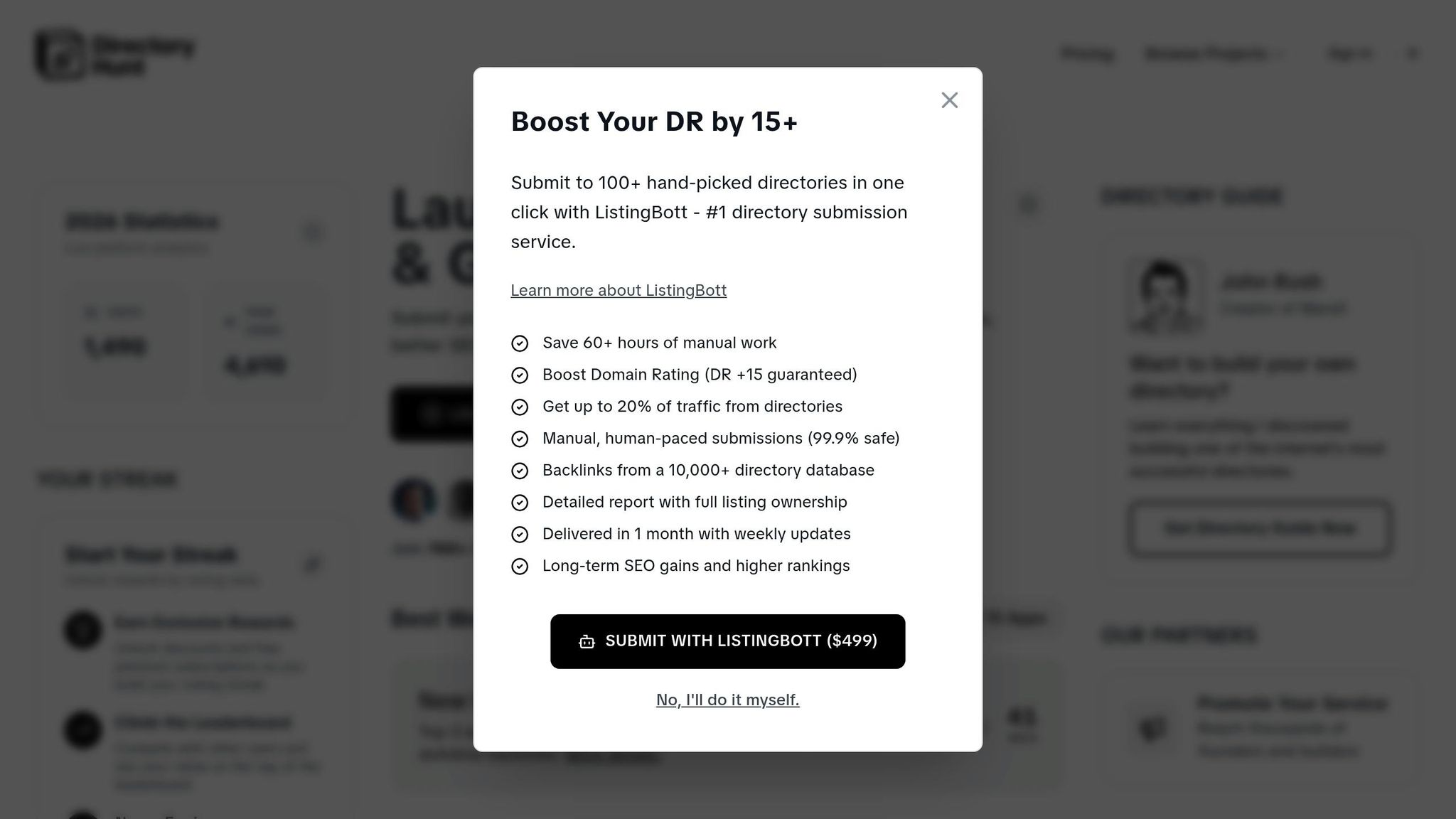
Manual directory submissions in 2026 can be a real drain on time and resources, especially for startups juggling multiple priorities. Spending hours submitting to directories takes valuable attention away from growing the business. That’s where Directory Hunt steps in, automating the submission process while maintaining the quality standards search engines demand today.
Features and Benefits of Directory Hunt
Directory Hunt’s ListingBott tool submits your business to over 100 handpicked directories, saving you from the hassle of manual work. Unlike low-quality link farms, these directories are carefully curated to meet modern algorithm standards, focusing on editorial quality and relevance. The platform also categorizes listings by industry, which can increase conversion rates by up to 2.3x compared to generic submissions.
For startups launching new domains, Directory Hunt helps establish trust signals that search engines use to verify business information across multiple platforms. The platform also offers detailed reporting, so you can track the status of your submissions and measure SEO benefits over time. This automation ensures your directory submissions are consistent, high-quality, and aligned with SEO best practices.
Directory Hunt Pricing Plans
Directory Hunt provides three pricing tiers designed with startups in mind, including options that fit within the typical $300–$800 monthly SEO budget for small businesses in 2026:
| Plan Name | Price | Features | Limitations |
|---|---|---|---|
| Free Projects | Free | Basic submissions to curated directories. | Limited features. |
| ListingBott | $499 | Automated submission to 100+ directories, detailed reports, and SEO tracking. | - |
| Premium Projects | Varies | Advanced tools, premium exposure, and AI-driven marketing options. | Pricing varies. |
The Free Projects plan allows you to test basic directory submissions without any cost. For startups looking for measurable results, the ListingBott plan at $499 delivers noticeable SEO improvements within 30–90 days. If you’re ready to go bigger, the Premium Projects plan offers advanced tools, including AI-driven features tailored for cutting-edge technologies like voice search and personalized recommendations.
Conclusion: Are Directory Submissions Still Worth It in 2026?
Here's the takeaway: directory submissions still have a place in 2026 - but only if approached with care and precision. Search engines continue to emphasize quality over quantity, favoring directories that are industry-specific, editorially reviewed, and verify the legitimacy of listed businesses. For startups and entrepreneurs, these submissions remain a powerful way to establish credibility, help new domains get indexed, and attract targeted referral traffic.
The key lies in being selective. Focus on directories with high authority, manual review processes, and relevance to your industry. Maintaining exact NAP (Name, Address, Phone number) consistency is critical - businesses with over 95% citation accuracy rank, on average, 3.2 positions higher in local search compared to those with only 70% accuracy.
"Quality over quantity isn't just a cliché - it's a survival principle for citation building." - Gombos Atila Robert, CEO of Jasmine Business Directory
For startups working within tight budgets, tools like Directory Hunt can provide affordable options for securing placements in reputable directories. Results from quality submissions often become evident within 30 to 90 days, with organic click-through rates increasing by 15-25% during that period.
In short, directory submissions in 2026 are about building trust, not just backlinks. By targeting the right platforms, adhering to best practices, and monitoring your outcomes, directory submissions can still be an effective and cost-efficient way to enhance your online presence. A thoughtful, quality-driven approach not only boosts visibility but also strengthens your credibility with both search engines and potential customers.
FAQs
What are the dangers of using low-quality directories for SEO in 2026?
Using low-quality directories for SEO in 2026 is more of a liability than a strategy. Search engines have grown smarter, placing a strong emphasis on quality, relevance, and authority when assessing backlinks. Submitting your site to directories that don’t meet these standards can backfire, hurting your rankings and your site's reputation.
These directories are often flagged as spammy, which can lead to penalties. Plus, they usually lack the editorial oversight or niche focus needed to make a positive impact. Instead of boosting your SEO, they can waste your time and even signal manipulative behavior to search engines.
The smarter approach? Stick to high-authority, industry-specific directories. These not only align with modern SEO practices but also contribute real value to your online presence.
What’s the best way to make directory submissions effective for SEO in 2026?
To make directory submissions work well for SEO in 2026, the key is quality over quantity. Focus on directories that have strong editorial standards, high domain authority, and are directly relevant to your industry or location. This can help establish your topical authority and improve your local SEO performance.
Consistency is critical, especially when it comes to your NAP details (Name, Address, Phone Number). Ensure this information is accurate and uniform across all listings to strengthen your local search rankings. Stay away from directories that rely on spammy or automated submissions - these can hurt your credibility. Instead, look for directories with manual review processes to maintain trustworthiness and avoid potential penalties. Industry-specific or niche directories are often more effective at driving targeted traffic and delivering better SEO results than general directories.
By focusing on a careful and quality-first strategy, directory submissions can still play an important role in boosting your online visibility and search rankings in 2026.
Why is it important to keep NAP information consistent for directory submissions in 2026?
Maintaining NAP consistency - your business's Name, Address, and Phone number - has become incredibly important in 2026. Why? Because search engines use this information to verify your business's legitimacy. When your NAP details are accurate and consistent across directories and platforms, it not only strengthens your local SEO but also makes it easier for customers to find and trust you.
On the flip side, outdated or mismatched details can create confusion for both users and search engines. This can hurt your visibility online and even damage your credibility. By keeping your business listings consistent, you reinforce your online presence and increase the chances of attracting the right audience.