
Best Free vs Paid Directory Listings: Full Breakdown

Best Free vs Paid Directory Listings: Full Breakdown
Directory listings help businesses improve online visibility and attract local customers. Free options like Google Business Profile are cost-effective but require more management and offer limited features. Paid listings, costing $60–$600+ annually, provide better visibility, priority placement, and advanced tools, often leading to higher-quality leads and improved SEO.
Key Takeaways:
- Free Listings: No cost, basic visibility, limited features, and lower-quality leads.
- Paid Listings: Higher placement, advanced analytics, dofollow backlinks, and better conversion rates (2–5% vs. 0.5–2% for free).
- SEO Impact: Paid listings boost rankings by 15–25%, while free listings see 3–8% improvement.
- Businesses combining free and paid listings can see 23% more traffic.
Quick Comparison:
| Feature | Free Listings | Paid Listings |
|---|---|---|
| Cost | $0 | $60–$600+ annually |
| Visibility | Standard placement | Priority placement |
| SEO Impact | Nofollow links | Dofollow links |
| Conversion Rate | 0.5–2% | 2–5% |
| Lead Quality | Lower intent | Higher intent |
| Management Effort | High | Low (automated) |
Free listings are ideal for startups or businesses on tight budgets. Paid listings work best for those seeking higher visibility, better leads, and stronger SEO results.
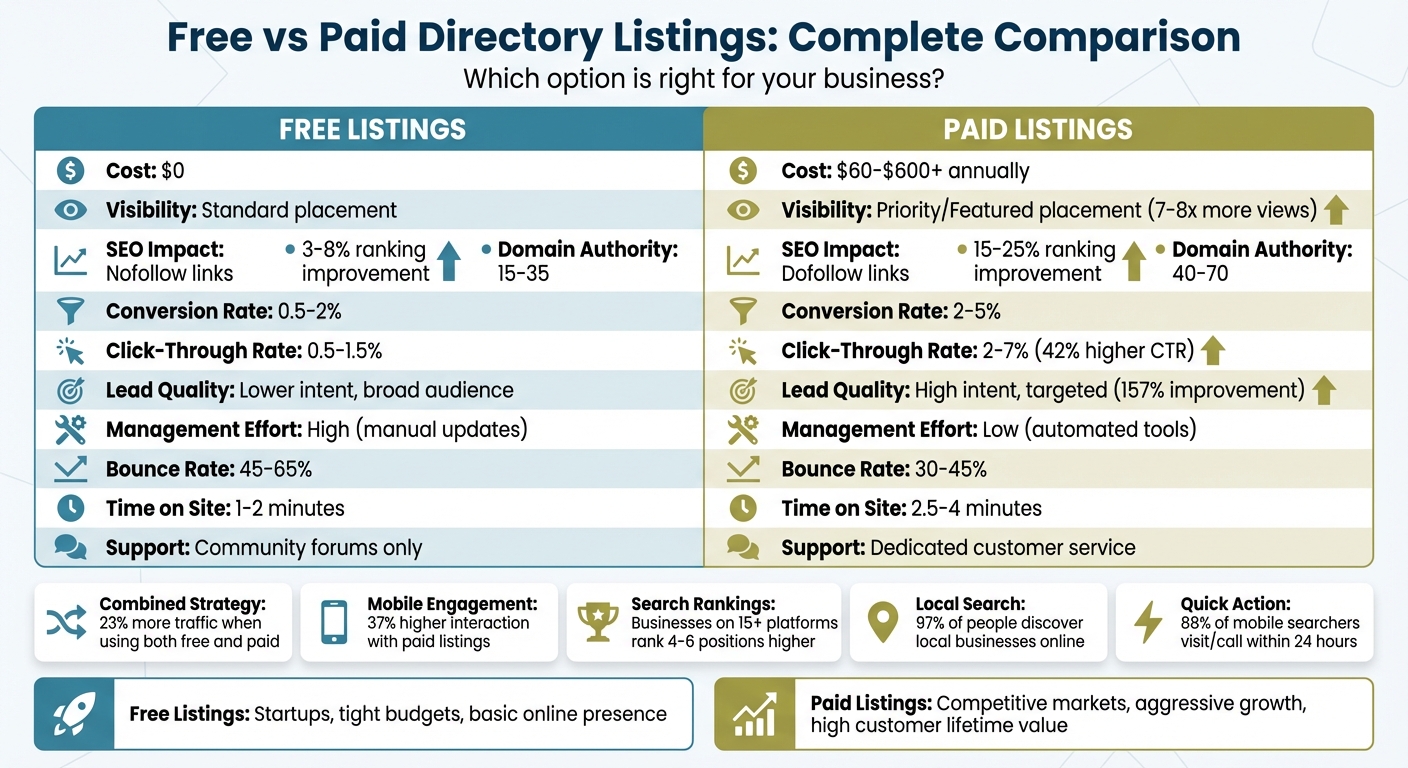
Free vs Paid Directory Listings Comparison Chart
Are Paid Directory Listings Worth It?
What Are Free Directory Listings?
Free directory listings serve as digital business cards, showcasing your basic business details like Name, Address, and Phone number (NAP), along with operating hours, categories, and a short description. These listings are hosted on platforms such as Google Business Profile, Yelp, and Bing Places, where potential customers often search for local services.
Beyond just listing your business, these directories play a role in your SEO strategy by strengthening local citations. Search engines rely on them to confirm your business's legitimacy and location. For example, when someone searches for "plumber near me" or "bakery in downtown", these directories help power the results. While the basic listing is free, platforms often monetize through premium features, advertising, or data aggregation.
Setting up a listing typically involves a verification process - either via postcard (which can take 5–14 days) or phone call - to confirm ownership. Once verified, your business can appear in local search results, Google Maps, and even niche-specific directories without requiring a financial investment.
"If a business can't be found on the web today, it's akin to being 'nowhere.'" - Moz
However, maintaining these listings requires ongoing effort. You'll need to update information like holiday hours, respond to reviews, and ensure details remain consistent across platforms. Neglecting this can create the impression that your business is inactive, which can erode customer trust.
Let’s dive deeper into the features, benefits, and potential downsides of free directory listings.
Features of Free Directory Listings
Free directory listings cover the essentials: business name, address, phone number, website URL, and a brief description (usually 50–100 words). Most platforms also allow you to upload a few photos and select business categories to help potential customers find you.
Some platforms, like Google Business Profile and Facebook, offer basic engagement tools. These include collecting and responding to reviews, answering customer queries, and posting updates. These tools not only engage customers but also contribute to local SEO by creating structured citations.
That said, free listings have their limitations. They often appear in standard or alphabetical order, meaning they’re less likely to be prominently featured in search results. Additionally, competitor ads might appear on your profile page, potentially diverting attention. Analytics for free listings tend to be minimal, usually limited to basic metrics like view counts, which can sometimes include bot traffic.
While these features provide a solid foundation for visibility, they come with certain trade-offs.
Benefits of Free Directory Listings
For small businesses and startups operating on tight budgets, free directory listings provide an easy way to gain online visibility without any upfront costs. Once your listing is created and verified, your business can start appearing in local search results.
Another benefit is the boost to SEO. Consistent directory listings across multiple platforms can significantly improve your local search ranking. In fact, businesses with consistent directory information across 15 or more platforms often rank 4–6 positions higher in local search results. With 97% of people discovering local businesses online and 88% of mobile searchers visiting or calling a business within 24 hours, the potential impact is clear.
One example: a local bakery increased foot traffic by 30% in 2025 by keeping its Google Business Profile updated with accurate hours and weekly specials. This required just two hours of management per week.
Drawbacks of Free Directory Listings
Despite their advantages, free directory listings come with limitations. They typically generate 30% to 50% less traffic than paid listings. Free options also have lower conversion rates - ranging from 0.5% to 2% compared to 2% to 5% for paid listings. Because free listings often appear below paid ads, they may receive less visibility.
Another drawback is the use of "nofollow" backlinks, which don’t pass SEO authority to your website. Paid listings, on the other hand, often provide "dofollow" links that can enhance your site’s SEO. Support for free listings is usually limited to community forums or automated responses, which can be frustrating if you run into issues.
"Free listings are like free puppies: the initial cost is zero, but the ongoing expenses will surprise you." - Gombos Atila Robert, CEO of Jasmine Business Directory
Keeping your listings accurate and up-to-date across multiple platforms can be time-consuming. Professional management services, which handle updates and resolve duplicate listings, can cost anywhere from $500 to $2,000 per month. Inconsistent or outdated information can confuse customers and hurt your credibility.
What Are Paid Directory Listings?
Paid directory listings involve a financial investment that unlocks additional features like better placement, enhanced marketing tools, and more advanced options for showcasing your business. Unlike free listings, which typically include only basic details (like Name, Address, and Phone - NAP) and "nofollow" links, paid options provide perks such as priority positioning, dofollow backlinks from reputable domains, and the ability to include rich content like videos and high-quality images. For businesses looking to improve visibility and maximize their return on investment, these premium features can make a big difference.
The payment model also helps maintain quality. By charging for listings, directories can deter spam and ensure more trustworthy, reliable entries with less manual oversight. Additionally, paid listings tend to attract users who are closer to making a purchase decision, resulting in higher conversion rates - 2% to 5% compared to 0.5% to 2% for free listings. These advantages make paid listings a strong option for businesses aiming to stand out.
Features of Paid Directory Listings
Here’s what sets paid listings apart from their free counterparts:
- Priority Placement: Your business appears at the top of search results or in featured sections, making it more visible to potential customers.
- Dofollow Backlinks: Paid listings provide links from high-authority domains, which can improve your website's SEO.
- Advanced Analytics: Premium plans often include tools like real-time dashboards, heat maps, and detailed conversion tracking to help you understand and optimize visitor behavior.
- Rich Media Options: Upload high-resolution photos, video tours, and professional galleries - features not typically available with free listings.
- Lead Management Tools: Many paid packages include features like direct inquiry forms, CRM integration, and call tracking to streamline customer interactions.
- Mobile Optimization: Interactive features, such as click-to-call buttons, make it easier for mobile users to engage with your business - boosting interaction rates by 37%.
- Ad-Free Profiles: Some premium tiers remove competitor ads from your business page, ensuring visitors stay focused on your offerings.
Benefits of Paid Directory Listings
The advantages of going premium extend beyond just better visibility. Businesses using paid listings often see:
- Higher Engagement: Premium listings achieve a 42% higher click-through rate (CTR) and convert at an average rate of 4.7%, compared to just 1.9% for free listings.
- Improved Lead Quality: Companies report a 157% increase in the quality of leads after upgrading to premium listings.
- More Views: Paid entries generate 7–8 times more views than free ones.
- Boosted Local Rankings: Featuring in high-authority directories can increase local search rankings by 15–25% within three to six months.
- Better Traffic: Combining free and paid listings can drive roughly 23% more website traffic than relying on free options alone.
- Voice Search Priority: Virtual assistants often favor verified, established directories, making paid listings more likely to appear in voice search results.
"While free directories will get you immediate listings, paid directories will get you higher quality listings... having high quality listings not only boosts your directory's reputation, it also comes with a few added perks like higher SEO rankings." - Business Directory Team
Drawbacks of Paid Directory Listings
Of course, there are downsides to consider. The most obvious is cost. Premium listings can range from $5 to over $500 annually, with an average monthly cost of around $49.50 projected for 2025. For competitive industries like legal services, costs can climb even higher, with click rates ranging from $8 to $20. In contrast, retail businesses might pay as little as $1 to $3 per click.
Other factors to keep in mind:
- Hidden Costs: Beyond subscription fees, you may need to invest 5–10 hours per month managing your listing, producing creative assets, or handling unexpected price increases after introductory offers expire.
- Activation Fees: Roughly 30% of paid directories charge one-time fees between $15 and $50.
- Ongoing Maintenance: Managing payments, analytics, and your brand’s presentation requires continuous effort.
- Limited ROI for High-Ranking Free Listings: If your free listing already performs well (e.g., appearing on the first page of search results), upgrading may not yield proportional benefits.
To make the most of paid listings, it’s essential to track your investment. Use tools like UTM parameters or unique tracking phone numbers to measure ROI and ensure your spending aligns with your business goals.
Directory Hunt Plans: Free vs Paid Options
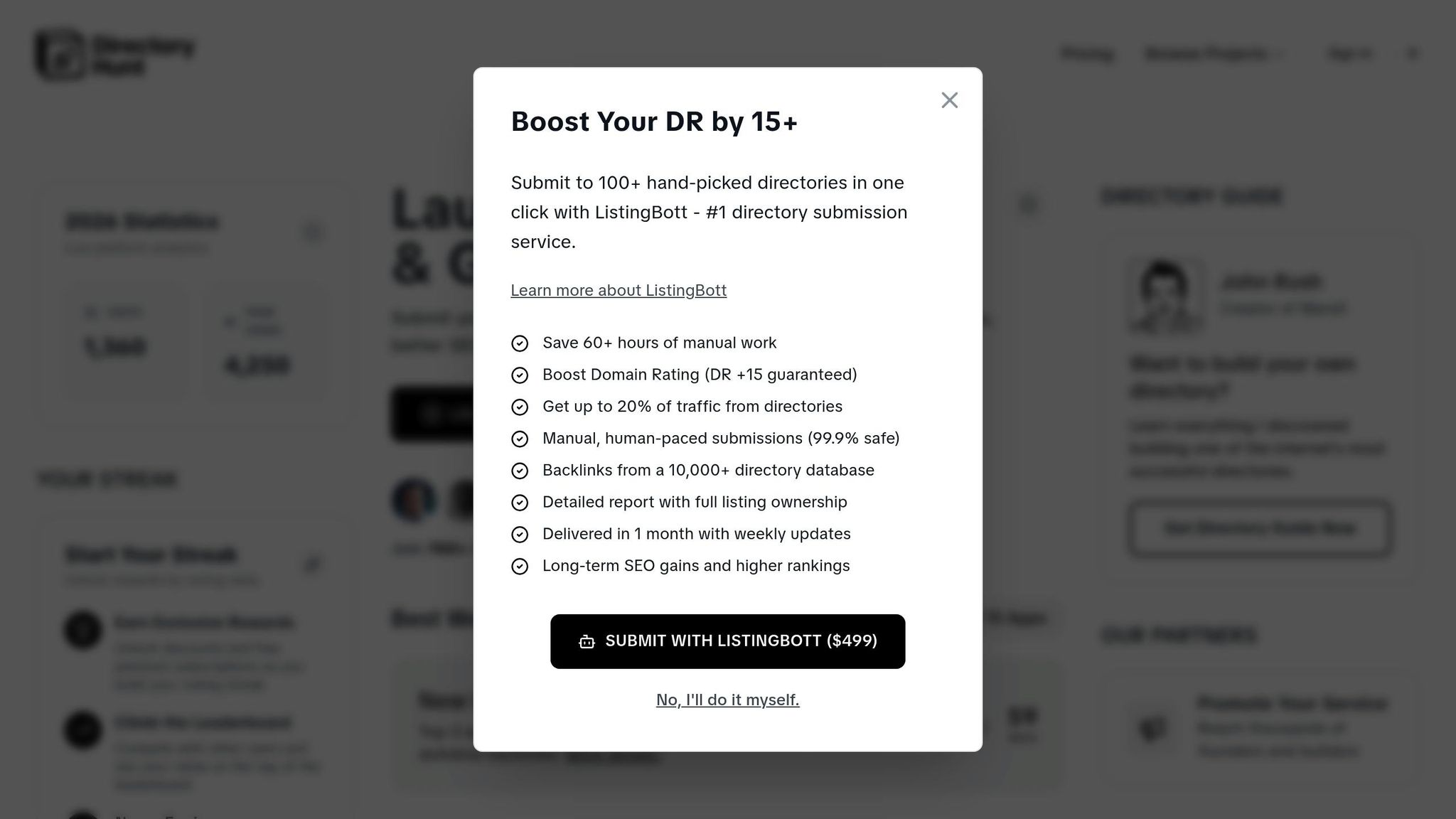
Directory Hunt offers three plans tailored to different business needs, whether you're a startup looking for a basic online presence or an established company aiming to improve local search visibility. Here's a breakdown of what each plan provides.
Free Projects Plan: What You Get
The Free Projects Plan is a no-cost option that helps establish your online presence. By submitting your project to Directory Hunt's curated directory, you can ensure consistent Name, Address, and Phone (NAP) data while gaining a quality backlink. This plan is perfect for startups wanting to create a digital footprint without spending money upfront.
Even with its simplicity, a free listing can make a noticeable difference. Accurate multi-directory listings can improve local search rankings, which is essential since 46% of all Google searches are local, and 88% of local mobile searches lead to a call or visit within 24 hours. Adding details like accurate hours and photos can further boost traffic - profiles with images generate 36% more customer leads. However, managing these listings manually can be labor-intensive, taking around 5 hours to handle submissions for just 20 directories. Plus, maintaining NAP consistency is critical, as 75% of failed submissions result from mismatched data.
ListingBott and Premium Projects: What You Get
ListingBott is priced at $499 and simplifies the process by automating submissions to over 100 directories. It also includes detailed reports and an integrated SEO suite, saving you a significant amount of time.
"How much time does Listing Management save me? Probably weeks of work so far." - Alex Muller, Marketing Director at Pinnacle Treatment Centers
For businesses looking for maximum visibility, Premium Projects takes it a step further with AI-driven tools and advanced marketing features. Premium listings receive priority placement, leading to 7–8 times more views and a 42% higher click-through rate compared to free listings. Paid listings also deliver better conversion rates - 4.7% in early 2025, compared to just 1.9% for free options. Businesses that upgrade often experience a 157% improvement in lead quality, making it a smart investment. For example, if your customer lifetime value is $500 and the annual cost is $1,000, you only need 2–3 qualified leads per year to break even.
Plan Comparison Table
| Feature | Free Projects | ListingBott | Premium Projects |
|---|---|---|---|
| Pricing | $0 | $499 | Premium Tier |
| Submission Type | Manual/Basic | Automated (100+ directories) | AI-Driven/Advanced |
| SEO Tools | Foundational SEO | Integrated SEO suite | Advanced AI insights |
| Visibility | Standard/Curated | High-Volume/Scalable | Priority/Featured placement |
| Lead Generation | Top-of-funnel awareness | Mid-funnel/Scalable | High-intent, AI-matched |
| Best For | Startups with limited budgets | Growing businesses | Established brands |
| Time Investment | High (manual management) | Low (automated) | Low (automated + analytics) |
This comparison highlights how each plan can support your SEO and lead generation goals, depending on your business stage and priorities.
sbb-itb-5806a15
Boost Your Project's Visibility
Submit your project to Directory Hunt to gain visibility, reach early adopters, and connect with a community of makers and entrepreneurs.
Submit Your ProjectSEO and Visibility: Free vs Paid Listings
Free and paid directory listings offer distinct advantages and limitations when it comes to SEO performance and visibility. Knowing how they differ helps you decide where to focus your resources for maximum impact.
SEO Results: Free vs Paid
Free listings typically provide "nofollow" backlinks, which don’t directly boost PageRank but still contribute to a natural and diverse backlink profile. Paid listings, on the other hand, often include "dofollow" backlinks from higher-authority domains, which deliver more direct SEO benefits. The difference in domain authority (DA) is also notable: free directories usually have a DA of 15–35, while paid directories often range between 40–70 due to stricter editorial standards.
"Quality trumps quantity when it comes to directory listings." – Gombos Atila Robert, CEO, Jasmine Business Directory
The SEO impact is clear. Paid directories with higher authority can boost rankings by 15–25% within 3–6 months. In contrast, free listings typically result in a modest 3–8% improvement. Businesses listing on 15 or more platforms may see their search positions improve by 4–6 spots.
| SEO Factor | Free Listings | Paid Listings |
|---|---|---|
| Link Type | Mostly Nofollow | Often Dofollow |
| Domain Authority | 15–35 | 40–70 |
| Ranking Impact | 3–8% improvement | 15–25% improvement |
| Backlink Profile | Natural/Incremental | Authoritative/Strong |
While SEO metrics are crucial, visibility and the quality of leads paint an even more complete picture of the differences between free and paid options.
Visibility and Lead Quality: Free vs Paid
The gap between free and paid listings widens when you consider visibility and lead quality. Paid listings often receive 7–8 times more views than free ones within the same directory. Free listings tend to get buried on page 3 or deeper, while paid listings secure prime spots on page 1 or even in featured sections. Additionally, free listings are often surrounded by competitor ads, which can divert potential leads.
Paid listings also tend to attract higher-quality traffic. Users engaging with premium listings are typically further along in their buying journey, leading to conversion rates of 2–5%, compared to 0.5–2% for free listings. Features like click-to-call make paid listings especially appealing to mobile users, who are 37% more likely to interact with these enhanced options. Businesses that combine free and paid listings see an average 23% increase in website traffic compared to those relying solely on free options.
| Metric | Free Listings | Paid Listings |
|---|---|---|
| Cost | $0 (but high time cost) | $5–$500+ annually |
| Exposure (CTR) | 0.5–1.5% | 2–7% |
| Lead Quality | Broad/Lower intent | Highly targeted/High intent |
| Conversion Rate | 0.5–2% | 2–5% |
| Ad Clutter | High (competitor ads) | Low (priority placement) |
The quality of traffic from paid listings extends beyond conversion rates. Paid options typically have lower bounce rates (30–45% vs. 45–65% for free listings), and visitors spend more time on-site - 2.5–4 minutes compared to 1–2 minutes. For businesses with high customer lifetime value, these differences can drive significant returns. Upgrading to premium directory listings can lead to a 157% improvement in lead quality on average.
How to Choose Between Free and Paid Listings
Deciding between free and paid listings depends on where your business stands, your budget, and your overall goals. Here's a breakdown to help you make the most of your resources.
When to Use Free Listings
Free listings work best for startups or businesses with tight budgets looking to establish a basic online presence. Platforms like Google Business Profile and Bing Places are great starting points - just make sure your profiles are fully optimized before considering any paid upgrades.
A handy rule of thumb is the "Page 3 Test": if your free listing doesn’t make it to the first two pages of search results within three months, it might be worth exploring paid options. Keep in mind that reviewing and updating 20 directories can take about five hours, which translates to a cost of $150–$300 in labor.
For startups aiming to keep costs at zero, Directory Hunt's Free Projects plan is a solid way to establish a basic digital footprint.
When to Use Paid Listings
If you’re ready to grow aggressively, paid listings can deliver a strong return, especially in highly competitive markets. In industries like personal injury law or home services, free listings often get overshadowed by paid placements, making premium options critical for visibility. The math is simple: if just one lead covers the annual premium cost, the investment is an easy decision.
Take this example: in 2025, a plumbing company spent $150 per month on featured placements. In six months, they gained 47 customers and generated over $18,000 in revenue - an impressive 600% ROI. Similarly, an estate planning firm invested $350 in premium listings and secured 17 new clients, bringing in over $25,000 in business within six months.
"100 highly targeted visitors from premium directories often generate more conversions than 500 general visitors from free listings." – Jasmine Directory
Many businesses adopt the 70/20/10 budget model: 70% goes to proven paid directories, 20% to testing new ones, and 10% to maintaining free listings. Tools like Directory Hunt’s ListingBott ($499) streamline submissions to over 100 directories, offering detailed reporting and long-term SEO benefits. For those looking to maximize exposure, Premium Projects provides advanced tools to drive leads and visibility.
To evaluate paid listings, divide the annual cost by your average customer profit. If landing just 2–3 leads covers the cost, it’s a low-risk move.
Conclusion
When deciding between free and paid directory listings, it’s all about aligning the features with your business goals. Free listings are a great starting point, providing essential NAP (Name, Address, Phone) details and basic citations to establish your online presence. On the other hand, paid listings, which typically cost between $5 and $500+ annually, deliver more impact - offering 7–8 times as many impressions, higher-quality dofollow backlinks, and conversion rates of 2% to 5%, compared to the 0.5% to 2% seen with free options.
Combining free and paid listings can be a game-changer. Businesses that use both tend to see about 23% more website traffic than those relying only on free options. Premium listings also bring stronger returns by driving more qualified leads and boosting conversion rates.
Directory Hunt simplifies this process with plans tailored to different business needs. The Free Projects plan is perfect for startups looking to establish an online presence without spending a dime. For those ready to scale, ListingBott ($499) automates submissions to over 100 directories and includes detailed reporting to strengthen long-term SEO. If maximum visibility and lead generation are your goals, the Premium Projects plan offers advanced tools to take your exposure to the next level.
FAQs
What are the benefits of using both free and paid directory listings?
Using a mix of free and paid directory listings can help businesses create a solid and effective online presence. Free listings are a budget-friendly way to get your business into multiple directories, which can boost visibility in local search results and build trust with potential customers. They’re especially handy for targeting niche markets or specific geographic areas.
On the flip side, paid listings come with added perks like higher placement in search results, more detailed profile customization, and access to advanced analytics. These features can improve visibility, increase click-through rates, and attract more qualified leads. By combining both free and paid options, businesses can cover a wide base with free listings while using paid ones to fine-tune performance and achieve better outcomes.
How can paid directory listings boost SEO compared to free ones?
Paid directory listings can play a big role in boosting your SEO efforts by providing high-quality backlinks. These backlinks can strengthen your website’s authority and improve its position in search engine rankings. On top of that, many paid directories offer extra perks like detailed business profiles, well-organized categories, and prime placements, making it easier for your target audience to discover your business online.
Another advantage is that paid directories often enforce stricter quality standards. This can enhance your credibility and ensure your listing is more relevant in search results. The result? Better visibility, more traffic to your site, and increased lead generation - a smart move for businesses aiming to grow.
When is it a good idea for a business to switch from free to paid directory listings?
When free directory listings no longer align with your goals for visibility, branding, or lead generation, it may be time to consider upgrading to a paid option. For example, if your free listing isn’t ranking well in search results or lacks features like premium placement, detailed analytics, or tools to manage customer reviews, a paid listing could enhance your online presence and boost credibility.
Paid listings often come with perks like higher rankings, more detailed profiles, and targeted advertising options, all of which can help drive traffic and increase conversions. If your competitors are leveraging paid listings to dominate local search results, upgrading might also be necessary to keep your business competitive. The decision ultimately depends on your goals, current visibility, and whether the potential return on investment makes sense for your business.