
Project Launch Checklist: 15 Steps to Get Noticed

Project Launch Checklist: 15 Steps to Get Noticed
Launching a project without preparation is risky - 23% of startups fail due to poor execution, and 55% of launches miss deadlines. This checklist simplifies the process with 15 steps to help you plan, optimize, and monitor your launch effectively. Here's what you'll learn:
- Set clear goals: Define your audience, value proposition, and SMART goals to measure success.
- SEO-ready website: Optimize keywords, meta tags, URLs, and schema markup for better visibility.
- Directory submissions: Build backlinks and boost rankings through high-authority directories like Directory Hunt.
- Post-launch tracking: Use tools like Google Search Console and analytics to monitor performance and refine your strategy.
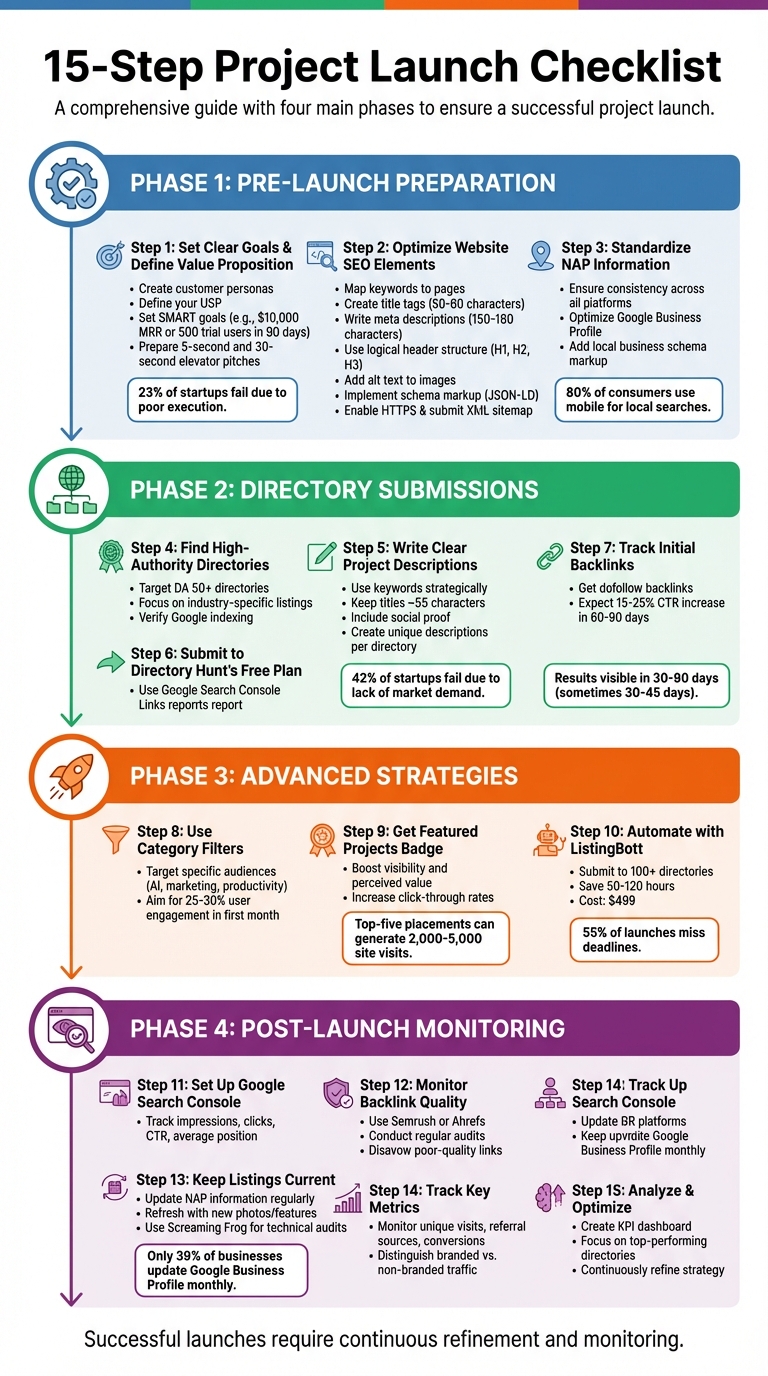
15-Step Project Launch Checklist: From Planning to Post-Launch Monitoring
Pre-Launch Preparation
Set Clear Goals and Define Your Value Proposition
Before diving into your launch, nail down exactly what you're building and who it’s for. Use tools like interviews, social media insights, and prototypes to validate demand for your idea. Then, define your target audience by outlining their demographics, behaviors, and pain points. This will help you create a detailed customer persona.
Your Unique Selling Proposition (USP) is what makes you stand out. To pinpoint it, figure out what matters most to your potential customers and see how your offering compares to competitors. Once you’ve got that clarity, set SMART goals - specific, measurable, achievable, relevant, and time-bound. For instance, aim to hit $10,000 in monthly recurring revenue or onboard 500 trial users within your first 90 days. Tracking progress through key metrics can double your chances of hitting these targets.
"You need to be ready to make your case - and sound intelligent - in both instances [the 5-second and 30-second pitch]." - ProductPlan
Prepare elevator pitches - both 5-second and 30-second versions - that tie your product’s features to the benefits users will experience. Share these goals and pitches with your team and stakeholders to ensure everyone’s on the same page about what success looks like.
Once your goals are clear, it’s time to get your website ready to drive results.
Optimize Your Website's SEO Elements
Your website should be search-engine-ready from day one. Start by mapping specific keywords to individual pages to avoid duplication and ensure precise targeting. Craft unique and accurate title tags for every page, keeping them between 50–60 characters and placing primary keywords at the beginning. Pair these with compelling meta descriptions (150–160 characters) that encourage clicks, even though they don’t directly impact rankings.
Use a logical header structure - one H1 per page, followed by H2s and H3s as needed. Create clean, keyword-focused URL slugs like /pets/cats.html instead of random strings of numbers or letters. Don’t forget to add alt text to all images to improve accessibility and help search engines understand your content. To enhance visibility in search results, implement schema markup in JSON-LD format, enabling features like review stars, FAQs, or product details to appear.
"Be the last click. In other words, make sure when people search for your keyword - and they eventually find you - you are the last result they need to click." - Cyrus Shepard, Moz
For technical SEO, make sure your site uses HTTPS for security, has a functional robots.txt file, and includes an XML sitemap submitted to Google Search Console. Post-launch, check indexing by running a site:yourdomain.com search and use Google’s Mobile-Friendly Test to ensure compatibility - after all, over 80% of consumers rely on mobile devices for local searches. If you’re redesigning an existing site, set up 301 redirects from old URLs to retain link equity.
Standardize Your NAP Information
Consistency in your Name, Address, and Phone number (NAP) is critical for local SEO and trustworthiness. Search engines use this information to assess your business’s legitimacy and relevance for local queries. Inconsistencies can confuse both search engines and potential customers.
Start by optimizing your Google Business Profile to ensure your address, phone number, and website URL match your site exactly. With only 39% of businesses updating their Google Business Profile monthly, staying on top of this gives you a competitive edge. Use listing management tools to scan for existing business listings and fix any errors in your NAP data. Adding local business schema markup to your site can also help search engines accurately identify your contact details.
Double-check that your contact details are consistent across social media profiles, email signatures, and directory listings. Even small discrepancies - like using "Street" on one platform and "St." on another - can hurt your local rankings and make it harder for customers to trust your business.
Full Website Pre-Launch Checklist (Walkthrough + Free Checklist)
Directory Submissions for Backlinks and Visibility
Directory submissions offer a simple yet effective way to build backlinks and improve your domain authority. High-quality directories not only provide valuable external links that enhance trust but also boost SEO. In fact, you can often see results within 30 to 90 days - and sometimes as quickly as 30 to 45 days when using directories with a Domain Authority (DA) of 50–80. Beyond SEO, directories can drive direct traffic, and ensuring accurate listings helps you avoid 404 errors.
Find High-Authority Directories
When it comes to directory submissions, quality matters more than quantity. Focus on directories with a DA of at least 30, though aiming for 50+ will yield better results. Tools like Moz, Ahrefs, or SEMrush can help you check a directory's DA and traffic stats before you submit. Directories that use human editors to review submissions are often more reliable and beneficial for SEO.
Industry-specific directories are particularly valuable. For example, if you're launching a productivity tool, submitting to directories focused on SaaS or business tools will provide better results than general listings. Local directories can also be a game-changer for geographic targeting, often improving local search rankings by 2 to 5 positions within 30 to 45 days. Be cautious of directories overloaded with ads, poorly designed navigation, or those that require reciprocal links. Always confirm that a directory is indexed by Google - if it’s not in search results, its backlinks won’t help your SEO.
Write a Clear Project Description
A well-crafted project description is key to standing out in directories. Start by identifying relevant keywords and placing them strategically in your title and opening sentence. Titles should stay around 55 characters, and descriptions should be concise - ideally under 120 characters - to avoid truncation in search results.
"Ask yourself: Who am I helping specifically – and with what? The clearer your benefit, the better." - Chantalle Alberstadt, Brand Designer
Focus on what makes your project unique and the specific benefits it provides. For instance, instead of a generic description like "a project management tool", try something more descriptive like "Task automation for remote teams managing 10+ projects simultaneously." Including social proof - such as user testimonials, rankings, or statistics - can further strengthen your listing. Avoid reusing the same description across multiple directories. Unique, keyword-rich content tailored to each directory prevents duplicate content issues and ensures your messaging resonates with different audiences.
Submit to Directory Hunt's Free Plan
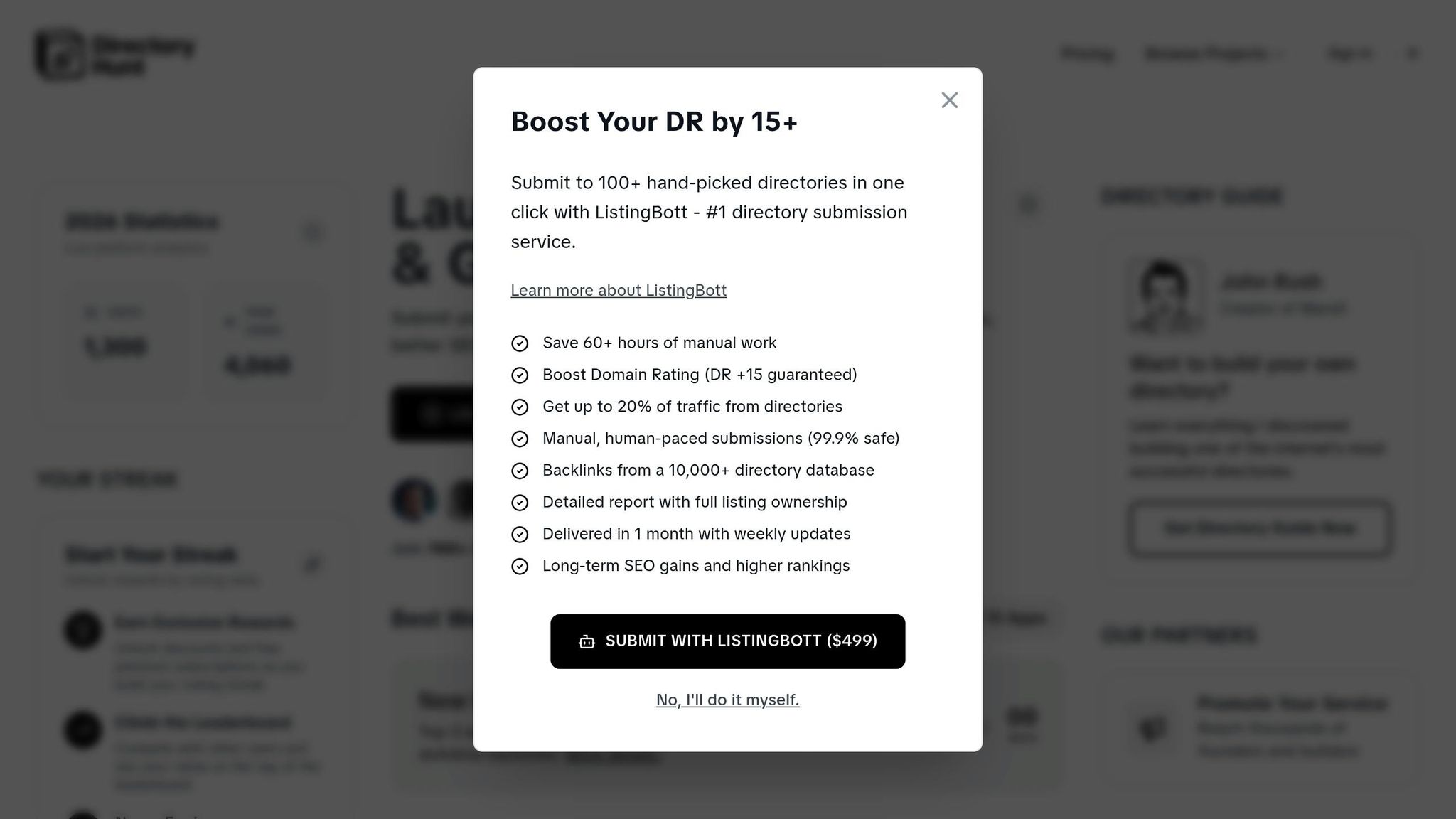
Once your project description is polished, take advantage of free submission options to build your backlink profile. Directory Hunt offers a free submission plan that provides dofollow backlinks and exposure across categories like AI, marketing, and productivity. This is an excellent starting point, especially when compared to paid programs that can cost anywhere from $300 to $3,000 per month.
Use Google Search Console's "Links" report to track when Directory Hunt's backlinks appear and assess their impact on your site's link profile.
"Focus on authority building - Proactively seek out high-quality backlinks from reputable websites to build your site's authority." - CRO:NYX Team
High-quality directory placements can lead to a 15% to 25% increase in organic click-through rates within 60 to 90 days. Starting with Directory Hunt’s free plan allows you to establish a strong backlink foundation without straining your budget. As your project scales, you can explore premium plans or automated submission services to expand your directory presence even further.
sbb-itb-5806a15
Boost Your Project's Visibility
Submit your project to Directory Hunt to gain visibility, reach early adopters, and connect with a community of makers and entrepreneurs.
Submit Your ProjectAdvanced SEO and Exposure Strategies
Once your foundational directory setup is complete, it's time to level up. By implementing advanced strategies, you can amplify your reach and make a bigger splash in your target market. These techniques build on your earlier efforts, ensuring your project gets the attention it deserves.
Use Directory Hunt's Category Filters
Selecting the right category for your project isn’t just about organization - it’s about connecting with the right audience. Directory Hunt’s category filters, such as AI, marketing, and productivity, help align your project with users actively searching for solutions in those areas. This targeted approach increases the likelihood of adoption by addressing the specific needs of your ideal users.
For example, if you’re launching a task automation tool, placing it in the productivity category ensures it reaches decision-makers like project managers and team leads. This strategic placement prevents your project from being buried in a general business directory. A good benchmark for adoption is having 25% to 30% of active users engage with your product within the first month. If you hit 50% or more, it’s a strong indicator that your project resonates with a core market need.
Beyond choosing the right category, standing out from the competition is critical.
Get a Featured Projects Badge
A Featured Projects Badge is like securing a billboard in a crowded marketplace - it ensures your project gets noticed. This premium badge highlights your listing within Directory Hunt, making it more visible to visitors who might otherwise overlook it. Think of it as a shortcut to grabbing attention and boosting engagement.
Applying for a featured badge not only increases visibility but also enhances your project’s perceived value. More clicks and traffic signal relevance to search engines, which can improve your rankings over time. It’s a small investment with the potential for significant returns.
While visibility is essential, streamlining your submission process can save valuable time.
Automate Submissions with ListingBott
Submitting your project manually to multiple directories can take anywhere from 50 to 120 hours. That’s where Directory Hunt’s ListingBott service comes in. For $499, ListingBott automates submissions to over 100 directories, saving you time and effort.
This service doesn’t just save hours - it also builds early social proof. You’ll receive performance reports to track traffic, backlinks, and engagement. To maximize the impact, ensure your key pages - like pricing, product details, and lead capture forms - are fully optimized and indexed. Once submissions are live, use Google Search Console to verify that backlinks are appearing and that your critical pages are being crawled.
The value of automation becomes apparent when you consider the alternative: manually submitting to over 100 directories is time-consuming and prone to errors. With ListingBott, you can focus on improving your product and engaging with users while the heavy lifting is handled for you.
Post-Launch Monitoring and Growth
Launching your project is just the first step. To ensure long-term success, you need to actively track performance. Without monitoring, you're essentially relying on guesswork. As Lida Stepul, SEO Specialist, puts it:
"If Google Search Console isn't set up, you're not doing SEO. You're hoping for the best."
Here’s how you can stay on top of your post-launch performance and fine-tune your strategy.
Track Backlinks and Keyword Performance
Google Search Console is your go-to tool for tracking vital metrics like Impressions, Clicks, Average Position, and CTR (Click-Through Rate). If your CTR is low, it might be time to tweak your titles and meta descriptions to make them more engaging.
For backlinks, tools like Semrush Backlink Analytics or Ahrefs can help you see which directory submissions are boosting your site's authority. Be cautious, though - poor-quality backlinks can harm your rankings. Regular audits are essential to identify and disavow links that could negatively impact your SEO.
Keep an eye on your target keyword rankings, but don’t obsess over daily fluctuations. As Stepul advises:
"SEO doesn't reward panic-checking. Set a schedule, watch your trends, and act when something's off, not every time your rank drops a position overnight."
To get a more complete picture, connect Google Analytics with Google Search Console. This integration allows you to correlate SEO traffic with user engagement metrics like bounce rate and time on site. This combined data helps you make informed adjustments when needed.
Keep Your Listings Current
Directory listings aren’t a “set it and forget it” asset - they need regular updates to stay relevant. Search engines favor profiles that are active and up-to-date. Ensure your NAP (Name, Address, Phone) information is consistent across all platforms to maintain trust and avoid confusing potential users. Schedule periodic audits to verify accuracy and refresh your listings with updates like new photos or feature announcements.
Use tools like Screaming Frog or Sitebulb to crawl your site and catch technical issues such as broken links, redirect chains, or "noindex" tags that could block indexing. Fixing these issues promptly ensures your site remains optimized and competitive.
Analyze and Improve Your Directory Strategy
Your initial directory submissions are just the beginning. Ongoing analysis ensures you’re getting the best return on your efforts. Set up a KPI dashboard to monitor key metrics like unique visits, referral sources, and conversions. This allows you to identify top-performing directories and adjust your focus accordingly.
Pay attention to the difference between branded traffic (users searching your specific name) and non-branded traffic (those finding you through industry keywords). This distinction helps you evaluate how well your directory strategy is working.
Here’s a quick guide to tracking directory performance:
| Metric | Tool to Use | What It Tells You |
|---|---|---|
| Impressions | Google Search Console | Your visibility in search results |
| Referral Traffic | Google Analytics 4 | Direct clicks from directory listings |
| Average Position | Semrush / GSC | The impact of directory links on your SEO |
| CTR | Google Search Console | How compelling your descriptions are |
If certain directories aren’t delivering results, reallocate your efforts to those that are. Tools like Directory Hunt can provide performance data to help you focus on strategies that yield the best outcomes. Whether it’s targeting specific categories, using featured badges, or automating submissions with tools like ListingBott, make sure you’re investing where it counts. As Rand Fishkin wisely reminds us:
"Nothing can be improved that is not tracked."
Conclusion
Launching successfully takes more than just a good idea - it’s about careful planning, smart visibility strategies, and constant fine-tuning. The 15 steps outlined here work together to create a launch strategy that drives results. It starts with setting clear goals and optimizing for SEO, moves into amplifying visibility through directory submissions, and ends with maintaining momentum by monitoring performance and making adjustments.
Consider this: 42% of startups fail because they build products that lack market demand. This statistic underscores the importance of pre-launch validation. These steps aren’t just tasks to check off - they’re what separate a launch that falls flat from one that gains real traction.
Tools like Directory Hunt play a key role in every stage of the process. From building backlinks with its free plan to boosting visibility with premium features, it helps you stand out in competitive markets. For instance, products that secure top-five placements can generate 2,000 to 5,000 site visits - a massive boost for any launch.
Given that only 55% of product launches happen on schedule, this checklist also helps you avoid common missteps and stay on track. By covering essentials like standardizing your NAP information and setting up Google Search Console, you’re setting the stage for a smoother launch.
But remember, the launch is just the beginning. Long-term success depends on what happens afterward - tracking performance, updating listings, and focusing on strategies that deliver results. SEO isn’t a one-time effort; it’s a continuous process. With the right groundwork and regular optimization, your project can achieve the visibility and growth it deserves.
FAQs
What’s the best way to set SMART goals for a successful project launch?
To set SMART goals for your project launch, aim for goals that are Specific, Measurable, Achievable, Relevant, and Time-bound. This framework helps you clarify what success looks like and how to get there.
Start by outlining clear, actionable objectives. For example, you might aim to attract 10,000 website visitors within the first month, secure 500 social media interactions per week, or hit a revenue target of $50,000 in the first quarter. These specific targets make it easier to measure progress.
Make sure your goals are realistic by considering your available resources, team capacity, and market conditions. Break these objectives into smaller milestones to track progress step by step. For instance, if the goal is to reach 10,000 visitors, set weekly visitor benchmarks to stay on track. Lastly, assign deadlines to create a sense of urgency and accountability for your team.
By following this approach, you’ll have a clear plan that not only guides your efforts but also ensures your project stays focused and aligned with your launch objectives.
What are the most important SEO steps to take before launching my website?
Before getting your website live, it's important to prioritize some SEO basics to ensure it gets the visibility it deserves. Begin by researching and selecting the right target keywords. These should be seamlessly woven into your content, page titles, and meta descriptions to align with what users are searching for.
Next, focus on on-page optimization. This means organizing your site with clear headings, user-friendly URLs, and a solid internal linking structure. These elements make it easier for both users and search engines to navigate your site.
Don't overlook technical SEO either. Set up redirects where needed, generate an XML sitemap, and verify your site through Google Search Console. These steps ensure search engines can index your site correctly, giving it a better shot at ranking higher in search results.
Why is it important to keep your business's name, address, and phone number consistent for local SEO?
Maintaining consistent Name, Address, and Phone Number (NAP) details across all online platforms is a cornerstone of local SEO. Search engines use this consistency to verify your business's authenticity and accuracy, which plays a key role in determining your position in local search results.
When your NAP information is inconsistent, it can confuse both search engines and potential customers. This can hurt your visibility and lead to missed opportunities. By keeping your NAP details uniform across your website, social media, directories, and review sites, you build trust and make it easier for customers to locate and contact your business.