
The Complete Guide to Directory Backlinks for SEO

The Complete Guide to Directory Backlinks for SEO
Directory backlinks are links from online directories that categorize websites by industry, location, or specialty. They help boost your website’s authority, improve search rankings, and drive targeted traffic. Here’s why they matter:
- Boost Rankings: High-quality directory backlinks signal credibility to search engines, improving your domain authority and local search visibility.
- Increase Traffic: Directories attract users actively searching for services, often resulting in higher conversion rates.
- Strengthen Local SEO: Consistent NAP (Name, Address, Phone) information across directories helps your business appear in local search results and the Google Local Pack.
Key Takeaways:
- Businesses with 30–35 quality backlinks can gain over 10,500 visits per month.
- Local businesses using 15+ high-quality directory citations are 68% more likely to rank in the Google Local Pack.
- Use tools like Google Search Console, Ahrefs, or Semrush to track backlink performance.
To get started, focus on niche and local directories, ensure consistent business details, and monitor results using UTM parameters. Quality over quantity is key - target directories with high trust and relevance to maximize SEO benefits.
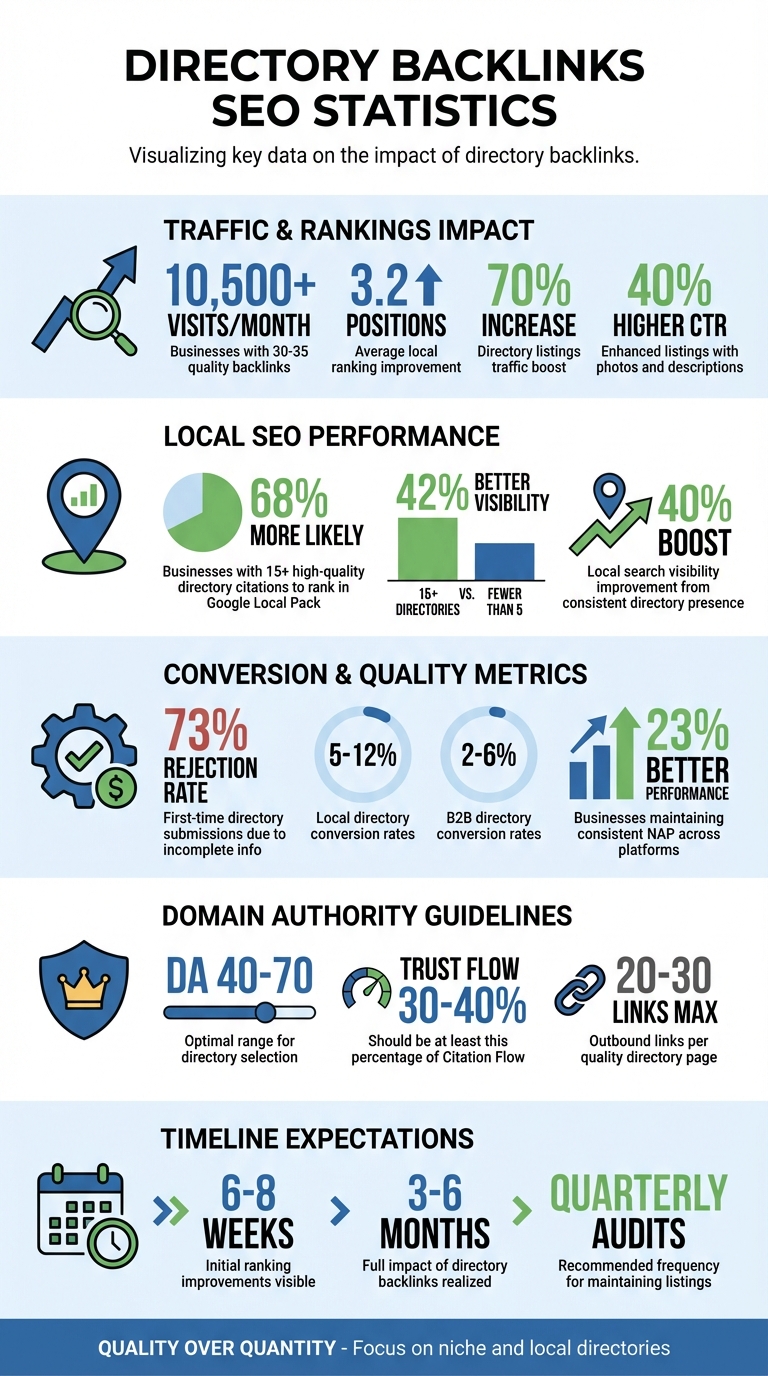
Directory Backlinks SEO Impact Statistics and Key Metrics
Backlinks With Niche Directories (Step-By-Step SEO Tutorial)
Benefits of Directory Backlinks for SEO
Directory backlinks offer three main advantages that can significantly influence your search performance: they help increase your domain authority, bring targeted traffic to your site, and enhance your local search visibility. Understanding these benefits allows you to prioritize the directories that make the biggest impact.
Improving Domain Authority and Rankings
One of the key benefits of directory backlinks is their ability to boost your site's authority and rankings. High-quality directories send strong credibility signals to search engines. For example, securing 30–35 quality backlinks can drive over 10,500 visits per month and improve local rankings by approximately 3.2 positions. However, quality matters more than quantity - a link from a DA 30 directory that aligns with your industry often outperforms a link from a high-DA generic site that lacks relevance. Additionally, search engines rely on directory listings to confirm your business’s legitimacy, which helps create a stronger digital presence and ensures faster indexing.
"Directory link building isn't dead - it's just evolved. Smart SEO professionals understand that high-quality directories can secure backlinks that add to authority and visibility."
- Gombos Atila Robert, PhD
To ensure you're targeting the right directories, look for those with a Trust Flow that's at least 30–40% of their Citation Flow. A low Trust Flow paired with a high Citation Flow could indicate a spammy directory.
Generating Referral Traffic
Directories aren't just about authority - they're also excellent for driving targeted traffic. These platforms attract users actively searching for specific services, making them a valuable source of high-intent visitors. Directory listings can increase traffic by 70%, and enhanced listings with photos and detailed descriptions can boost click-through rates by up to 40%. Visitors from directories are often further along in their decision-making process, which means they are more likely to convert. For instance, a boutique accounting firm saw a 34% growth in organic traffic over six months, while a family law attorney achieved a 127% increase in neighborhood-specific visibility by focusing on hyperlocal directories. To track the effectiveness of your directory listings, use unique UTM parameters for each directory URL and write compelling descriptions with clear calls to action.
Strengthening Local SEO
Directory backlinks also play a critical role in local SEO by sending geographic signals to search engines. These signals confirm your business's connection to a specific area, which is essential for appearing in the Google Local Pack. Businesses with 15 or more high-quality directory citations are 68% more likely to show up in the Local Pack compared to those with fewer citations. For example, an HVAC company that listed itself in 25 relevant directories improved its Local Pack position from 8 to 2 within four months. Start by submitting your business details to major data aggregators like Data Axle, Localeze, and Foursquare. From there, expand to hyperlocal directories, such as city-specific business groups or neighborhood guides, to further boost your local rankings.
"Local link building is fundamentally different from general SEO link building. While national brands chase high-authority publications, local businesses can earn powerful links through community involvement."
How to Find Quality Directories
When evaluating directories, don't just focus on domain authority (DA). For instance, a directory with a DA of 45 that actively promotes listings can outperform a DA 65 directory that's neglected and inactive. Generally, directories with a DA between 40 and 70 strike the right balance - offering solid SEO benefits without the high costs of premium placements. These considerations are key to determining a directory's real value.
Criteria for Evaluating Directories
Start by assessing a directory's editorial standards. High-quality directories rely on human editors to manually review submissions, a process that typically takes 2–14 days. Be wary of directories offering instant approval - this is often a sign of spam.
Focus on niche and geographic relevance rather than just authority metrics. Backlinks from industry-specific or local directories often carry more SEO weight than generic high-authority sites. In fact, niche directories tailored to specific markets can boost customer acquisition rates by as much as 40%.
Check the directory's indexation using the site:example.com search command. If the directory claims thousands of listings but only a fraction appear in search results, it's likely not valuable. Other technical factors to verify include SSL certification, fast page load speeds (under 3 seconds), and mobile responsiveness.
Examine the link quality by inspecting the source code. While "nofollow" links can enhance traffic and diversify your backlink profile, "dofollow" links directly impact rankings. For Trust Flow, aim for directories where Trust Flow is at least 30–40% of their Citation Flow. A high Citation Flow paired with low Trust Flow often signals spam.
"Quality beats quantity every single time."
- Gombos Atila Robert, CEO of Jasmine Business Directory
Warning Signs to Avoid
Steer clear of directories with excessive outbound links. A trustworthy directory page should have no more than 20–30 outbound links. Pages overloaded with hundreds of links dilute SEO value. Also, avoid directories with poor design, cluttered layouts, or grammatical errors - these often prioritize revenue over quality.
Watch out for questionable directories that list reputable businesses alongside shady entities like get-rich-quick schemes, gambling sites, or dubious pharmaceuticals. Such associations can lead to search engine penalties. Use the Wayback Machine to check a directory's history - directories with a long-standing and consistent track record are generally more reliable.
Pay attention to referring domain ratios. If a directory has 10,000 backlinks but only 50 referring domains, that's a major warning sign. Additionally, ensure the directory supports consistent NAP (Name, Address, Phone number) formatting. Inconsistent information across directories can confuse search engines and harm local SEO efforts.
"The lower the bar of entry into any directory, the less inclusion into that directory is valued by the search engines."
- Cyrus Shepard, Link Building Expert
sbb-itb-5806a15
Boost Your Project's Visibility
Submit your project to Directory Hunt to gain visibility, reach early adopters, and connect with a community of makers and entrepreneurs.
Submit Your ProjectDirectory Submission Strategies
Getting directory submissions right requires attention to detail. Did you know that 73% of directory submissions are rejected on the first try due to incomplete or inaccurate information? That’s a staggering number. But when done correctly, directory submissions can boost local search visibility by 40%.
Optimizing Your Submissions
Start by standardizing your business information. Create a centralized document with your Name, Address, and Phone number (NAP), along with logos and any necessary legal details. Even small inconsistencies, like using "Street" in one listing and "St." in another, can confuse search engines and hurt your rankings.
Category selection is another key step. Always choose the most specific primary category for your business - think "Italian Restaurant" instead of the broader "Restaurant." Use secondary categories only if they are directly relevant.
Your business description is where you can stand out. Write a 150–300 word unique description that incorporates long-tail keywords and location-specific terms. Avoid generic templates and instead highlight what makes your business special. Listings with optimized descriptions typically see a 15–25% higher click-through rate.
Here’s an example of success: A Houston-based HVAC company shifted its focus from national directories to regional, Texas-specific ones. This change led to a 47% increase in leads, as local directories attracted more engaged users. Similarly, a plumbing contractor prioritized 15 trade-specific directories over 100 general ones. Within six months, his leads grew by 60%, and the quality of inquiries improved significantly.
Don’t forget to complete verification steps (via postcard, phone, or email) as soon as possible. Also, schedule quarterly audits to keep your information up to date. Businesses that maintain consistent details across platforms enjoy 23% better search engine performance.
These steps lay the groundwork for leveraging tools like Directory Hunt to maximize your SEO results.
Using Directory Hunt for SEO
Once your submissions are optimized, platforms like Directory Hunt can help amplify your efforts. Directory Hunt specializes in curated categories for industries like AI, marketing, and productivity - making it a great fit for tech startups and digital entrepreneurs. The platform provides dofollow backlinks, which directly improve search rankings, and offers added visibility through features like category-based filtering and project badges.
For those looking to save time, automation tools like ListingBott can handle submissions to over 100 directories for $499. What’s great about ListingBott is that it combines automation with manual oversight, ensuring that your listings meet directory requirements while maintaining precision.
Finally, make sure your website is ready for directory submissions. Use SSL (HTTPS), ensure your site scores above 70 on Google PageSpeed Insights, and confirm it’s mobile-responsive. Quality directories often reject sites that are slow or insecure.
"Directory submission isn't dead; it's just evolved. While many marketers still treat it like a spray-and-pray link-building tactic from 2005, smart businesses understand that intentional directory placement can deliver genuine value."
- Gombos Atila Robert, CEO of Jasmine Business Directory
Tracking Directory Backlink Performance
Once you've optimized your directory submissions, the next step is figuring out their impact on your SEO efforts. Without tracking, it's tough to know which listings are helping and which aren't. Here's how to use key metrics to measure success.
Metrics to Monitor
Start by keeping an eye on metrics like Domain Rating (DR) or Domain Authority (DA). These scales, ranging from 0–100, measure the overall strength of your backlink profile. Industry surveys reveal that 44% of SEO professionals rely on Ahrefs' Domain Rating as their go-to metric, and 64% prefer Ahrefs' link data over other tools.
To track referral traffic from directory listings, use UTM parameters (e.g., ?utm_source=directory_name&utm_medium=listing). You can also create custom segments to analyze performance. For instance, local directory listings often show conversion rates between 5–12%, while B2B directories typically convert at 2–6%.
Keyword rankings are another critical indicator. Tools like Google Search Console allow you to monitor target keywords weekly. For local businesses, tracking "near me" searches and Local Pack appearances is especially important. Data shows that businesses listed consistently across 15 or more directories see 42% better local search visibility compared to those with fewer than five listings.
Consistency is key when it comes to your NAP (Name, Address, Phone number). Small differences like "Street" versus "St." can confuse search engines. Conduct quarterly audits to catch and fix these inconsistencies early. Additionally, monitor your Toxicity Score using tools like Semrush. Links from spammy directories (with scores between 60 and 100) can harm your rankings or even result in penalties.
Tools for Backlink Monitoring
Here are some tools to help you track and manage your backlinks effectively:
- Google Search Console: This free tool offers a "Links" report that shows linking sites, targeted pages, and anchor text. While it's great for an overview, it lacks the depth of paid tools.
- Ahrefs: Often considered the gold standard in backlink tracking, Ahrefs provides metrics like Domain Rating and URL Rating. Its Site Explorer tool accesses a massive index of 35 trillion external backlinks, making it a favorite among SEO pros. Plans start at $29/month for the Starter plan or $129/month for Lite.
- Semrush: Known for its Backlink Audit tool, Semrush calculates a Toxicity Score to identify harmful links. With a database of over 43 trillion links, it’s a powerful option for spotting low-quality directories. Pricing begins at $129.95/month for the Pro plan.
- Moz Link Explorer: This tool focuses on Domain Authority and Page Authority, which help predict ranking potential. Plans typically start at $99/month for Standard. For local SEO, tools like Moz Local or BrightLocal can automate citation tracking across multiple directories.
- Linkody: At $14.90/month for up to 2,500 links, this tool offers basic monitoring and email alerts for link changes. Free options like Backlink Pilot can also notify you if a directory removes your listing, giving you a chance to address the issue quickly.
"One of the best features of Backlinks is seeing which links were lost due to another site's structure changes - not removal. We found a few high-authority placements... where the linking site had redesigned or shifted content. The links weren't deleted maliciously, they'd just broken quietly."
- Michelle Symonds, Founder and Managing Director, Ditto Digital
Conclusion
When it comes to directory backlinks, quality now outweighs quantity in driving SEO success. Modern directories serve as essential building blocks for your online presence, offering trust signals, boosting local search rankings, and delivering targeted referral traffic to your site.
Businesses that invest in comprehensive directory listings often see significant results. Within six months, many report improved local search visibility and up to 70% more website traffic compared to those without directory coverage. These numbers highlight the importance of a well-thought-out directory strategy as part of a broader SEO plan.
"The question isn't whether directory backlinks still matter - it's how to work with them effectively within a comprehensive SEO strategy." - Gombos Atila Robert, PhD, CEO of Jasmine Business Directory
Earlier sections of this guide explained how to find high-quality directories and optimize your submissions. Now, the key to success lies in consistently applying those strategies. Focus on relevance, not sheer authority. Submitting to 5–10 niche-specific directories will deliver far better results than flooding 100 generic ones. Maintain NAP (Name, Address, Phone) consistency across all listings, craft unique descriptions, include rich media, and stagger your submissions over time to ensure a natural link-building pace. Use tools like Google Search Console, Ahrefs, or Semrush to monitor which directories provide the best return on investment.
Think of directory backlinks as a long-term project. Start small with a few high-quality submissions, update them regularly, and treat them as an ongoing effort. Most businesses notice initial ranking improvements within 6–8 weeks, with the full impact becoming evident over 3–6 months. To stay ahead, conduct quarterly audits, refresh your information, and optimize listings to keep them engaging and effective.
FAQs
How can directory backlinks help boost local SEO?
Directory backlinks play a key role in improving local SEO by increasing your business's visibility in location-based searches. These links are sourced from local or regional directories that are relevant to your area, helping search engines better understand your business's connection to a specific location. This can lead to higher rankings in local search results and improve your chances of showing up in Google’s local pack.
Another benefit of directory backlinks is that they help maintain consistent NAP (Name, Address, Phone number) details across various platforms. This consistency not only builds trust but also ensures accurate citations. Using high-quality directories like Google My Business, Yelp, or listings from your local Chamber of Commerce can be especially effective. They provide authoritative, location-specific citations that strengthen your local SEO strategy.
How can I determine if a directory is high-quality for SEO?
To find a directory that can genuinely boost your SEO, there are a few important things to keep in mind. Start by examining the directory's domain authority and reputation. Well-regarded directories are more likely to provide backlinks that actually make a difference. You’ll also want to look at their editorial standards - directories that enforce clear rules and avoid spammy listings tend to offer better quality.
It’s equally important to check the relevance to your industry or niche. Directories tailored to your specific field often bring in more focused traffic and can help you rank higher in searches that matter to your business. If you’re working on local SEO, prioritize directories that cater to your geographic area - these can be a goldmine for connecting with nearby customers. Lastly, consider whether the directory has active user engagement and steady traffic. A directory with a lively audience can help amplify your reach and bring in more visitors.
By paying attention to these factors, you can pinpoint directories that truly align with and strengthen your SEO efforts.
How can I monitor the success of my directory backlinks?
To gauge how well your directory backlinks are performing, keep an eye on essential metrics like the number of referring domains, the quality of those backlinks, and how they affect your search engine rankings. Conducting regular backlink audits is a smart way to confirm that your links are relevant, credible, and positively contributing to your SEO efforts.
Tools like Google Search Console are incredibly helpful for this. They let you check reports on who’s linking to your site, your most-linked pages, and other useful details. For a deeper dive, you can turn to specialized SEO tools that offer more detailed analytics. These tools can help you evaluate the overall health of your backlink profile and pinpoint areas that need improvement.
By regularly analyzing these metrics, you’ll be able to fine-tune your directory backlinks and ensure they’re making the biggest possible impact on your SEO strategy.