
How to Submit Your SaaS to 50+ Directories Fast
How to Submit Your SaaS to 50+ Directories Fast
Submitting your SaaS to 50+ directories can improve your visibility, generate referral traffic, and build high-quality backlinks that boost your SEO. However, manual submissions can take over 40 hours, making the process tedious. Here's how to streamline it:
- Prepare Your Assets: Create consistent business details (name, address, phone), write SEO-optimized descriptions, and gather visuals (logos, screenshots, demo videos).
- Target High-Impact Directories: Focus on trusted platforms like Product Hunt, G2, and Capterra for maximum exposure. Use niche directories for specific audiences.
- Use Automation Tools: Platforms like ListingBott save time by automating submissions to relevant directories.
- Track Results: Monitor backlinks, traffic, and domain rating using tools like Google Search Console and UTM parameters.
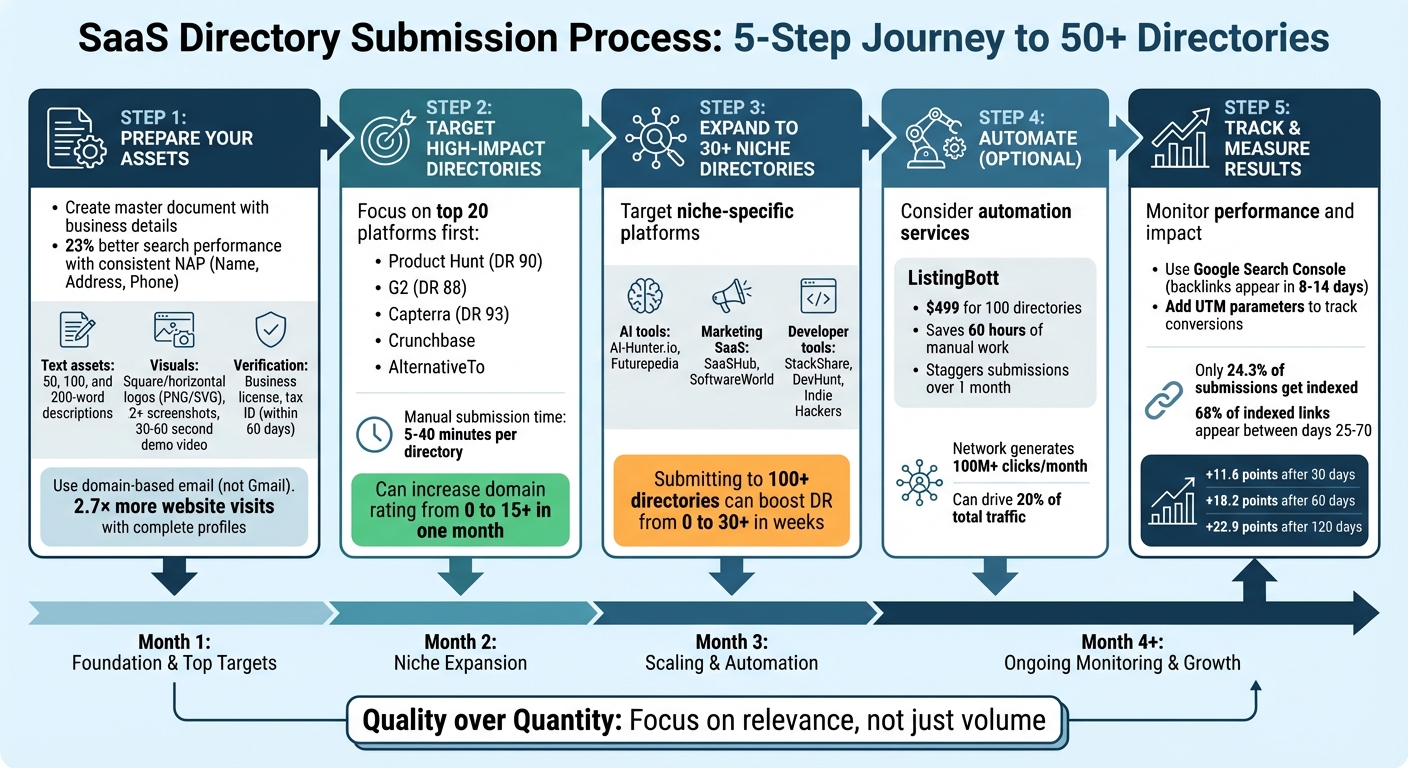
Complete SaaS Directory Submission Process: From Preparation to Tracking Results
Preparing Your SaaS for Directory Submissions
To get started with directory submissions, you’ll need a master document that holds all your business and product details. This should include your company name, address, phone number, product descriptions, and links, ensuring consistency across all directories. Why? Because companies with consistent information across platforms report 23% better search engine performance.
Your preparation should focus on three main areas: text assets, visuals, and verification documents. For text, create product descriptions in 50, 100, and 200-word formats to meet the varying requirements of directories. For visuals, gather square and horizontal logos (transparent PNG or SVG), at least two product screenshots showcasing its "aha moment", and a 30–60 second demo video or GIF. Many premium directories also ask for legal documents like a business license or tax ID to verify legitimacy.
Pay close attention to NAP consistency (Name, Address, Phone). Even small differences, like using "Street" in one directory and "St." in another, can confuse search engines and harm your SEO. Also, use a domain-based email (e.g., info@yourbusiness.com) instead of generic ones like Gmail, as this boosts approval rates with directory reviewers. Complete profiles matter - a business with a full directory profile receives 2.7× more website visits than one with incomplete listings.
Create a Complete SaaS Profile
A strong SaaS profile is essential. Start with a primary tagline that clearly states your product’s outcome and audience in one sentence. Follow it with 2–3 sentences explaining the problem you solve and 3–5 bullet points outlining your core capabilities - avoid jargon. Be upfront about pricing; if your plan costs $499, say so instead of using vague "Contact us" buttons.
| Asset Category | Required Materials | Specifications |
|---|---|---|
| Copy/Text | Tagline, Problem Context, Capabilities | 50, 100, and 200-word versions |
| Visuals | Logo, Screenshots, Demo Video | PNG/SVG; 1080×608 for cover photos |
| Company Info | Legal Name, NAP, Founder Bios | Must match official registration |
| Verification | Business License, Tax ID | Recent (within 60 days) |
| Technical | Website URL, UTM Links, Support Email | Domain-based email required |
Before submitting, conduct a technical audit of your website. Ensure it has a valid SSL certificate and runs smoothly on mobile devices - directories often reject insecure or broken sites.
Write SEO-Optimized Directory Descriptions
Your directory descriptions need to grab attention immediately. Start with a two-line hook that focuses on outcomes, not features. For example, instead of "Our platform has advanced analytics", say, "Track customer behavior patterns to improve retention." Sprinkle in keywords naturally - avoid stuffing them in awkwardly, as directories penalize spammy descriptions.
"Relevance is the new PageRank; you can't just submit anywhere." - Priya Garg, LinkedIn
Structure your description like this: open with your tagline, explain the problem you solve, list 3–5 key capabilities, add social proof (if available), include pricing details, and finish with a single call to action. Keep in mind that only 24.3% of directory submissions actually get indexed by search engines, so focus on quality over quantity.
Select the Right Categories for Your SaaS
Choosing the right category is critical - it determines who finds your product. Start with a broad category and narrow down to the most specific subcategory that fits your SaaS. Specific categories attract buyers with high intent who are actively searching for solutions like yours.
Look at where your competitors are listed. If you notice a trend in their category choices, it’s a good sign your audience is searching there too. Stick to 2–3 highly relevant categories; spreading yourself too thin can harm your SEO and make your listing appear unfocused.
"The more precise the category, the higher the relevance and conversion." - Krzysztof Cichy, Founder, LaunchDirectories
Your primary category carries the most weight for search relevance, while secondary categories can help broaden your reach. Align these choices with your buyer’s journey - some categories work better for discovery, others for evaluation and comparison. As AI tools like ChatGPT and Claude increasingly rely on directories for recommendations, precise categorization becomes even more important.
Submitting to the Top 20 High-Impact SaaS Directories
Once your SaaS profile and assets are ready, it’s time to focus on submitting to the top 20 directories that can amplify your online presence. Platforms like Product Hunt, G2, Capterra, Crunchbase, and AlternativeTo are well-known for their strong domain authority and active user bases, making them essential for boosting your product’s visibility and credibility. These directories don’t just provide backlinks - they serve as trusted research hubs that can enhance your brand’s reputation.
On average, manual submissions take anywhere from 5 to 40 minutes per directory, depending on the complexity of the form and account setup. But the effort is worth it: strategic submissions can elevate a new domain’s rating from 0 to 15+ in just one month.
Step-by-Step Guide for Major Platforms
Start with Product Hunt, a go-to platform for launching new apps. For the best results, submit your product early in the morning (PST) between Tuesday and Thursday. You’ll need a concise one-line pitch, animated screenshots (GIFs work well), a pricing overview, and an active founder presence during launch day. Product Hunt is perfect for generating early buzz and signups, especially during your product’s discovery phase.
For G2 and Capterra, focus on aligning your product with the right categories and providing detailed feature descriptions. These review-centric platforms thrive on verified customer feedback, so encourage users to leave reviews at key moments, such as after onboarding. Consistent reviews help build credibility over time. G2 is independent, while Capterra operates under Gartner, making both highly respected in the software space.
Crunchbase is a must for showcasing your startup’s legitimacy and attracting potential investors. Submissions typically require your official company name, founding date, funding details (if any), and founder bios. Meanwhile, AlternativeTo targets users actively looking for alternatives to their current tools. Ensure your product is accurately tagged and mapped against competitors to appear in relevant searches.
Before submitting to any directory, verify its Google indexing using the "site:" search operator (e.g., site:directoryname.com). If a directory isn’t indexed, it won’t provide SEO value. Also, avoid submitting to directories without SSL certificates, as search engines may penalize links from insecure domains.
| Platform Type | Examples | Primary Outcome | Time Investment |
|---|---|---|---|
| Launch/Discovery | Product Hunt, Hacker News | Awareness spike, early signups | Medium |
| Review Directories | G2, Capterra, GetApp | Social proof for evaluation | High |
| Comparison Sites | AlternativeTo | High-intent switcher traffic | Low |
| Startup Databases | Crunchbase | Investor visibility, authority | Medium |
To track the effectiveness of your submissions, use UTM parameters on your website links. This allows you to measure which directories are driving signups and demo requests, rather than just generating empty traffic. Most backlinks will appear in Google Search Console within 8–14 days, with broader indexing occurring between 25–70 days.
Directory Hunt: Your Starting Platform
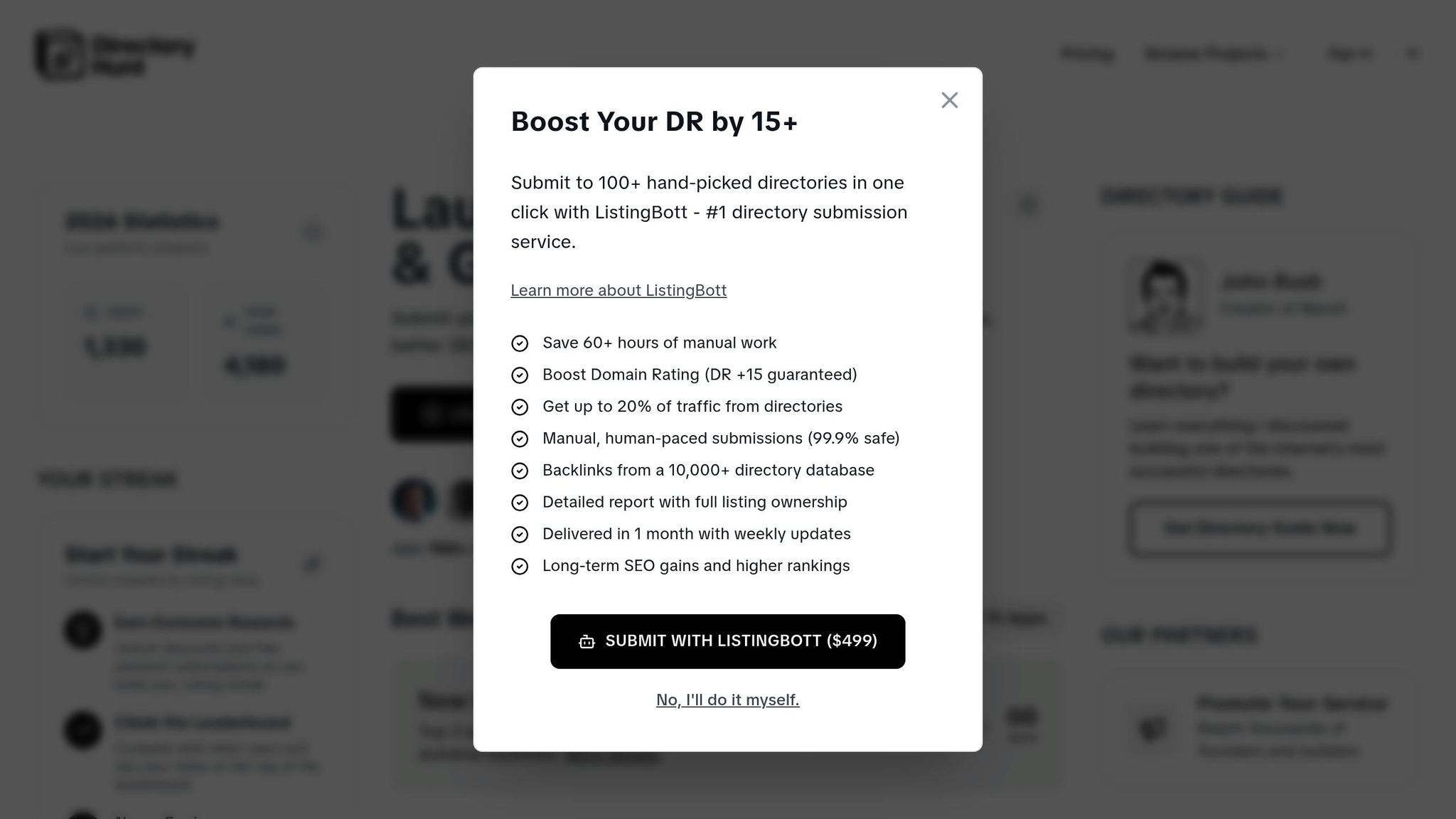
If you’re looking for a streamlined way to begin, Directory Hunt is an excellent tool. It provides a curated checklist of high-authority directories, including major players like Product Hunt and Crunchbase, ensuring you don’t miss any critical platforms. Designed with SaaS startups and side projects in mind, Directory Hunt offers both free and paid submission options to help you gain initial exposure and build essential backlinks.
Directory Hunt specializes in dofollow backlinks, which can improve your domain authority and SEO. The platform organizes directories by category - such as AI, marketing, and productivity - making it simple to find submission opportunities tailored to your niche. This targeted approach is crucial, as Priya Garg, an industry expert, explains:
"Relevance is the new PageRank; you can't just submit anywhere."
Kick off your directory submissions with Directory Hunt, then gradually expand to niche-specific platforms. Its curated list saves you time by steering you away from low-quality directories that won’t get indexed. This way, you can focus on quality over quantity and ensure your efforts truly make an impact.
Expanding to 30+ Niche SaaS and Startup Directories
After covering the major platforms, it's time to broaden your reach by tapping into niche directories. These platforms may not have the massive user bases of Product Hunt or G2, but they attract highly targeted traffic - people actively searching for solutions in specific categories. Here's why this matters: in 2024, 33% of B2B buyers reported relying more on peer recommendations and reviews compared to the previous year, with 31% ranking peer reviews among their top three research resources. Niche directories help you connect directly with these decision-makers.
The trick is finding directories where your ideal customers are already looking. For example, if you’ve developed an AI tool, platforms like AI-Hunter.io, There's An AI For That, and Futurepedia are excellent places to list your product. Marketing SaaS solutions, on the other hand, perform well on directories like SaaSHub and SoftwareWorld, which cater to small and medium-sized businesses. Developer tools see the best results on StackShare, DevHunt, and Indie Hackers, where engineers discuss integrations and tech stacks. By listing on 100+ directories, you can boost your domain rating from zero to 30+ in just a few weeks.
These niche platforms are a perfect complement to your overall strategy, helping you engage users who already have specific needs in mind.
List of Niche Directories for SaaS
Different products thrive on different directories. Here's how you can match your SaaS to the right platforms:
- AI tools: Platforms like AI Awesome, AI Gems, AI Stage, and toolsfine.com are hotspots for early adopters exploring automation and GPT-4 integrations.
- Marketing and general SaaS: Sites such as Capterra, GetApp, and SoftwareWorld offer structured comparisons that help users during the evaluation phase.
- Developer and productivity tools: Directories like StackShare, Indie Hackers, and DevHunt focus on tech stacks and developer communities.
- Design-focused SaaS: Bookmarks.Design is tailored specifically for designers looking for innovative tools.
- Early-stage and indie projects: Platforms like BetaList, TinyLaunch, Shipybara, and MicroLaunch are perfect for gaining early traction and securing your first users.
Many niche directories, such as SaaSHub, Indie Hackers, AlternativeTo, StackShare, and Fazier, allow free submissions. If you're looking to boost visibility faster, paid options like BetaList (early-stage exposure), Uneed (featured spots), and TechCrunch (paid profiling) are available but not essential for initial growth. When evaluating directories, consider these four factors: Audience fit (are your potential customers here?), Intent match (is the platform for discovery or decision-making?), Proof potential (can you showcase testimonials or logos?), and Link quality (check the Domain Authority and link attributes).
Tips for Niche Directory Submissions
To maximize your impact, tailor your submissions to the audience of each niche directory. Platforms like StackShare require technical details such as architecture diagrams, SDK links, and integration documentation. Meanwhile, AI directories benefit from examples like prompts, use-case matrices, and demo GIFs. As Krzysztof Cichy, Founder of LaunchDirectories, puts it:
"A listing is not a brochure. It is a compact conversion surface that must persuade in seconds".
Focus on clear, results-driven language. For example, instead of saying "advanced analytics dashboard", try "reduce reporting time by 60%." Your listing should include a concise tagline, a 2-3 sentence summary of the problem you solve, and 3-5 bullet points highlighting your core features.
Visuals can make or break your listing. Use annotated screenshots or short (45–60 second) product tours to demonstrate a key feature or workflow. Animated GIFs often outperform static images because they quickly show functionality in action. Don't forget to add UTM parameters to your links (e.g., ?utm_source=stackshare&utm_medium=directory&utm_campaign=launch) so you can track which directories lead to signups versus just clicks.
sbb-itb-5806a15
Boost Your Project's Visibility
Submit your project to Directory Hunt to gain visibility, reach early adopters, and connect with a community of makers and entrepreneurs.
Submit Your ProjectAutomating Directory Submissions with ListingBott
Spending 60 hours on manual directory submissions is no small task. That's where automation becomes a lifesaver. Directory Hunt’s ListingBott takes the reins, using AI and expert reviews to submit your SaaS to 100 carefully chosen directories from a database of over 10,000 high-quality sites.
How ListingBott Works
Here’s the process: after paying $499 (beta pricing for the first 2,000 users), you’ll receive an onboarding email. This email guides you to fill out a single form with your product details. You’ll also define your main goal - whether it’s boosting your Domain Rating (DR), increasing traffic, or both. From there, the AI identifies the most relevant directories based on your niche, such as AI tools, NoCode platforms, Dev Tools, or marketing SaaS.
Rather than submitting your listing everywhere in one go, ListingBott staggers the process over a month to avoid triggering spam flags. You stay in control, approving or rejecting specific directories before submissions go live. As John Rush, the founder of ListingBott, puts it:
"I built ListingBott because I needed it myself. I use it for my own startups. My AI agents & robots scan the internet daily for new directories."
At the end of the month, you’ll receive a detailed report of all approved listings, giving you full ownership. This streamlined approach not only saves time but also sets the foundation for long-term SEO and traffic growth.
Benefits of Automated Submissions
The time saved with automation is undeniable, but the SEO advantages are where the real magic happens. For example, in September 2024, Jerad Maplethorpe managed to triple his Monthly Recurring Revenue (MRR) within eight months. He credited automated directory listings via ListingBott as a major factor, with directories in the network generating over 100 million clicks per month. Some founders even report that these listings drive up to 20% of their total traffic.
Beyond traffic, automated submissions help build dofollow backlinks from high-authority sites like Capterra (DR 93), Product Hunt (DR 90), and G2 (DR 88). These backlinks boost your credibility with search engines, gradually improving your Domain Rating. For instance, in November 2024, Zarema Khalilova recommended ListingBott to a founder with a DR of just 12, highlighting it as a way to reach at least DR 20.
Tracking Submissions and Measuring Results
Keeping tabs on your directory submissions is essential to understand which listings are driving traffic, generating quality backlinks, and improving search rankings. Without tracking, it’s nearly impossible to measure the success of your efforts.
Tools for Tracking Your Submissions
Once your directory submissions go live, tracking their performance becomes critical. Start by using the "Links" report in Google Search Console to identify recognized backlinks from directories. Typically, you’ll begin to see activity within 8–14 days. Another handy method is using the site: operator in Google (e.g., site:directoryname.com "Your SaaS Name") to confirm if your submission has been indexed.
To stay organized, maintain a spreadsheet that logs key details such as the directory’s link policy (whether links are dofollow, nofollow, or sponsored), the submission date, and the live URL. For better tracking of referral traffic, signups, or demo requests, append UTM parameters to your links. For example: ?utm_source=directoryname&utm_medium=listing&utm_campaign=directories.
If you prefer a professional touch, some services provide detailed verification reports, complete with direct links and screenshots as proof of manual submissions. Additionally, adding a simple question like "Where did you first hear about us?" in your signup forms can help capture leads that might not show up in traditional referral tracking.
Measuring SEO and Traffic Improvements
Once you’ve set up tracking, it’s time to evaluate how directory submissions affect your SEO and traffic. For instance, a study tracking six new domains over four months in 2026 revealed that only 24.3% of submissions were indexed. B2B SaaS listings performed slightly better, with an indexing rate of around 27%. Interestingly, 68% of indexed links were discovered between days 25 and 70, while the remaining 32% took anywhere from 70 to 180 days to show up.
You can also monitor your Domain Authority (DA) or Domain Rating (DR) using tools like Ahrefs or Moz. On average, new domains see DA increases of 11.6 points after 30 days, 18.2 points after 60 days, and 22.9 points after 120 days. At the same time, keep an eye on your spam score, which typically rises slightly - from 1.2 to 2.4 - but should remain below 5.
Before submitting to any directory, double-check that it has a valid SSL certificate (look for the padlock icon in your browser) and confirm that the directory itself is indexed by Google. These steps ensure you’re not wasting time on low-quality or untrustworthy directories.
Conclusion
Getting your SaaS listed in 50+ directories lays a strong foundation for your SEO efforts. As Krzysztof Cichy, Founder of LaunchDirectories, explains:
"Directory submission is the foundation of SaaS SEO success. Without getting listed on directories, you're competing with established players who have years of directory listings advantage".
The difference between a brand-new domain stuck at DR 0 and one climbing to DR 15+ in just weeks often boils down to strategic directory submissions.
This approach revolves around three key steps: creating a detailed profile, focusing on high-authority and niche directories, and tracking results using tools like Google Search Console and UTM codes. Keep in mind that only 24.3% of submissions actually get indexed, so prioritizing quality over quantity is critical. Submitting to irrelevant directories can even hurt your SEO. Staying focused on relevance ensures you’re building a strong, sustainable foundation.
Once your strategy is ready, it’s time to act. Whether you prefer manual or automated submissions, the most important thing is to start. These listings become long-term assets that can drive organic traffic and improve rankings well into the future. And with AI tools like ChatGPT and Claude now scanning directories for product recommendations, you’re optimizing for more than just Google - you’re positioning your SaaS to be discovered across a broader digital landscape.
Start with your primary submission platform and then expand to high-impact directories like Product Hunt, G2, and Capterra. From there, branch out into niche directories that align with your target audience. The effort you invest today will continue to pay dividends for years.
FAQs
What are the advantages of using automation tools for submitting your SaaS to directories?
Automation tools bring serious time-saving benefits to SaaS startups by simplifying the process of submitting products to multiple directories. What might take hours manually can now be done in a fraction of the time. For startups operating with limited resources, this means more time to dedicate to the tasks that matter most to growing the business.
Beyond saving time, these tools ensure accuracy and consistency across all listings. With fewer chances for errors or conflicting information, your brand’s credibility remains intact. Plus, they make scaling your efforts a breeze - allowing you to submit to dozens of directories all at once without breaking a sweat.
One of the biggest perks? Automation tools can boost your SEO game. By generating quality backlinks from reliable directories, they help improve your product’s visibility and search engine rankings. In short, these tools are a game-changer for getting your product noticed while keeping the workload manageable.
How can I keep my SaaS profile consistent across all directories?
To keep your SaaS profile consistent across directories, focus on maintaining uniformity in your business name, address, and phone number (NAP). These details are essential for improving SEO and building trust with your audience.
Start by conducting an audit of your information to ensure everything is accurate. Use the same formatting for your NAP across all platforms. If updates are needed, apply them everywhere simultaneously to avoid any mismatches. Automated tools can simplify this process, helping you save time and minimize errors.
By ensuring consistency in your profiles, you not only boost your search rankings but also enhance your brand's credibility, making your SaaS appear more reliable and professional to potential users.
Why is selecting the right category for my SaaS in directories so important?
Picking the right category for your SaaS in directories isn’t just a minor detail - it’s a game-changer. It ensures your product reaches the audience most likely to need and appreciate it. This boosts your visibility, makes it easier for potential users to discover your solution, and positions your product alongside other trusted and relevant offerings, which can build credibility.
On top of that, getting the category right can give your SEO a boost. It helps search engines clearly understand what your product is about and where it fits in its niche. The result? More traffic, better user engagement, and stronger performance in those directories.